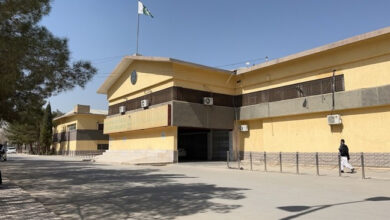
Scorching Balochistan: Heatwaves and the water crisis driving migration
Story by : Mujeeb Ullah
Balochistan, Pakistan’s largest and most sparsely populated province, is no stranger to harsh environmental conditions. Its arid deserts, rugged mountains, and coastal plains have long shaped a resilient way of life for its people. Yet, in recent decades, an intensifying force extreme heat has begun to redefine the region’s climate, pushing its ecosystems and communities to the brink. This long-form piece delves into the patterns of extreme heat in Balochistan, its broader climate impacts, the alarming depletion of underground water, and the resulting migration spurred by water scarcity. Supported by data and expert insights, it paints a picture of a province at the forefront of a worsening climate emergency.
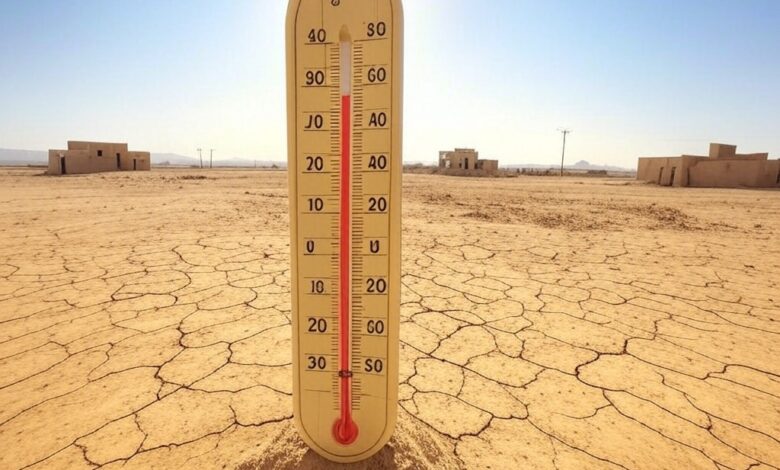
Balochistan’s climate has always been marked by extremes, but the frequency and intensity of heatwaves have escalated dramatically. The province spans diverse geographical zones coastal areas like Gwadar and Pasni, arid inland plains such as Sibi and Turbat, and highland plateaus like Quetta and Ziarat. Historically, summers brought searing heat to the lowlands, with temperatures often exceeding 45°C (113°F), while the highlands offered milder respite. Today, this distinction is blurring as extreme heat blankets the province more uniformly and persistently.
Data from the Pakistan Meteorological Department (PMD) reveals a clear warming trend. In Turbat, a city in southern Balochistan, temperatures soared to 53.7°C (128.7°F) in May 2017 one of the highest ever recorded globally at the time. Sibi, another lowland hub, hit 53°C (127°F) in May 2010, setting a national record. These are not isolated incidents. A 2018 study in Earth Interactions analyzing temperature extremes from 1980 to 2015 across four Balochistan cities (Pasni, Jiwani, Khuzdar, and Dalbandin) found statistically significant increases in warm temperature indices, such as the frequency of days exceeding 40°C (104°F). The Mann-Kendall test applied in this study confirmed a consistent upward trend, signaling a “clear picture of warming” across the region.
Seasonal shifts compound the problem. Summers are lengthening, with heatwaves arriving earlier and lingering later. In Quetta, once known for its cool summers, average maximum temperatures have risen by approximately 0.025°C per year since the 1980s, according to agrometeorological data analyzed in a 2021 Natural Hazards study. This gradual but relentless increase aligns with global climate change patterns, driven by rising greenhouse gas emissions and intensified by regional factors like deforestation and urban heat islands.
Extreme heat is not an isolated phenomenon it cascades through Balochistan’s environment and society, amplifying existing vulnerabilities. The province’s arid and semi-arid climate, already prone to drought, is now locked in a feedback loop with rising temperatures. Reduced rainfall down by 2.936 mm annually per the same Natural Hazards study coupled with higher evaporation rates, has shriveled surface water sources like rivers and seasonal streams. The 2022 floods, while devastating, were an anomaly amid a broader trend of declining precipitation, with the PMD noting a 52% rainfall drop in Balochistan between September 2024 and mid-January 2025.
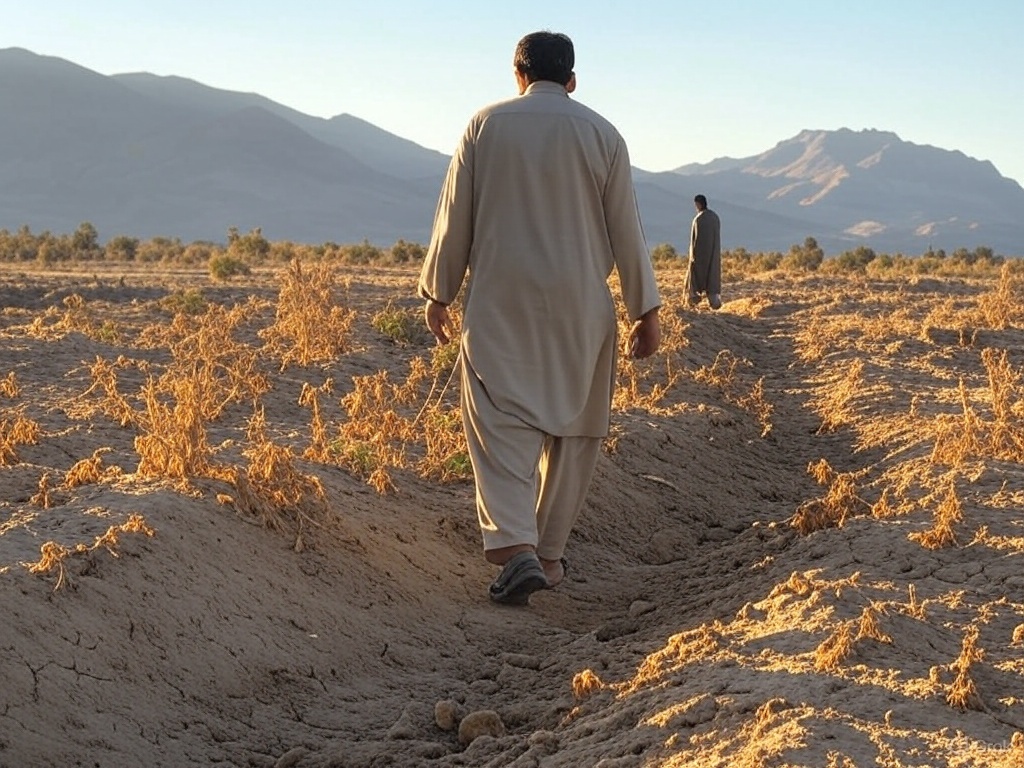
Agriculture, the backbone of Balochistan’s economy, bears the brunt. Crops like wheat, barley, and dates, reliant on scarce water, are failing more frequently. Livestock, a lifeline for rural communities, perish in droves during prolonged heatwaves and droughts. Noor Bibi, a 60-year-old widow from Gwadar, told The Friday Times in 2025, “We used to have enough water for our animals and fields. Now, the wells are dry.” Her story reflects a broader reality: heat-induced water scarcity is unraveling livelihoods.
Health impacts are equally dire. Heatwaves have driven a surge in heatstroke cases, overwhelming Balochistan’s limited medical infrastructure. Dr. Shabana Baloch, a physician in Turbat, reported to The Friday Times that “heatstroke cases are rising every year, and we lack proper healthcare facilities to handle the surge.” The World Meteorological Organization identifies heatwaves as the deadliest weather-related disaster globally, a statistic borne out in Balochistan’s rising morbidity rates during peak summer months.
The numbers tell a stark story. In 2022, Turbat’s 53.7°C heatwave made it one of the hottest places on Earth that year, a benchmark repeated in subsequent summers. The Natural Hazards study projected temperature increases of up to 0.7°C by 2040 and 1.2°C by 2060 under current emission scenarios, with precipitation potentially dropping by 161.48 mm by 2040. These forecasts suggest that extreme heat will become the norm rather than the exception.
Historical drought events further highlight the heat’s toll. The Standardized Precipitation Index (SPI) identified severe droughts in 1996, 2001-2002, 2004, 2009, and 2014 across Balochistan, with Barkhan experiencing a 22-month dry spell from 1999 to 2001 the longest on record. A 2021 MDPI study on drought trends noted a statistically significant decline in precipitation at stations like Quetta and Dalbandin, reinforcing the link between heat and water scarcity.
Balochistan’s reliance on groundwater via tube wells and the traditional karez irrigation system has intensified as surface water dwindles. But this lifeline is fading fast. Over-extraction, driven by population growth and agricultural demand, has depleted aquifers at an alarming rate. In Quetta, the water table has dropped over 800 feet in recent decades, with some estimates suggesting a decline of 3-6 meters per year across the province’s uplands.
The Eurasia Review reported in 2023 that illegal tube wells, often operated by the so-called “Tanker Mafia,” number over 2,000 around Quetta alone, far outstripping the Water and Sanitation Authority’s (WASA) 450-500 functional wells. This unregulated pumping, exacerbated by heat-driven evaporation, has rendered older wells obsolete and pushed new drilling costs skyward. In drought-hit areas, water levels have sunk beyond 1,200 feet, a depth unattainable for many rural communities.
Climate change accelerates this crisis. Higher temperatures increase evapotranspiration, reducing groundwater recharge even during rare rains. A 2024 MDPI study on water quality in Balochistan warned that unpredictable weather patterns and inefficient governance have left aquifers both depleted and contaminated, threatening public health and food security.
As water vanishes, so do livelihoods, forcing migration within and beyond Balochistan. Rural families, unable to sustain farming or livestock, abandon villages for urban centers like Quetta and Karachi. Noor Bibi’s sons, for instance, left Gwadar for Karachi to find work after their wells dried up. Climate expert Dr. Muhammad Tahir Khan, speaking to Dawn in 2023, noted, “In drought-hit parts of the province, people don’t have water for themselves and their livestock. So, they are compelled to leave their homes.”
This internal displacement strains urban infrastructure already ill-equipped for population growth. Gwadar, a coastal city facing both drought and sea-level rise, has seen protests over water and food scarcity escalate into broader unrest, as documented in a 2024 Mongabay study. Some residents, like fishermen unable to ply their trade amid environmental collapse, migrate internationally, often via perilous routes to Europe or the Middle East.
The Migration Policy Institute draws parallels with Iran, where heatwaves and water shortages have displaced hundreds of thousands, suggesting Balochistan could follow a similar trajectory. The 2021 Natural Hazards survey found 64.7% of Balochistan’s population is exposed to drought impacts, directly or indirectly, fueling a slow but steady exodus.
Experts are unequivocal: Balochistan’s extreme heat and water crisis demand urgent action. Dr. Kamran Ali, a water management specialist quoted in The Friday Times, advocates for “rainwater harvesting and desalination plants” as potential game changers. He warns that without better strategies, groundwater reserves will collapse within decades. Dr. Tahir Khan echoes this, lamenting the lack of a “proper mechanism” to cope with climate threats, a sentiment shared by Chief Minister Jam Kamal in 2018 when he launched the Balochistan Environmental Protection Council though progress remains slow.
The Intergovernmental Panel on Climate Change (IPCC) urges nations to cut emissions and adopt resilient policies, a call Pakistan struggles to heed amid political instability. Locally, experts like those in the 2024 Alternatives journal study emphasize data-driven governance and community inclusion in planning, noting that weak infrastructure and socioeconomic inequalities amplify climate-conflict risks.
Balochistan stands at a crossroads. Extreme heat, once a seasonal challenge, is now a year-round specter, draining water reserves, upending lives, and driving migration. The data 53.7°C in Turbat, 800-foot water table drops, 64.7% drought exposure underscores a crisis that cannot be ignored. Experts plead for innovation and investment, from renewable energy to water conservation, but time is running out. Without swift, coordinated action, Balochistan risks becoming a cautionary tale of climate collapse a province where heat and scarcity rewrite the future of its people.