Cheraman Juma Mosque: India’s First Mosque and a Landmark of Islamic History in Kerala
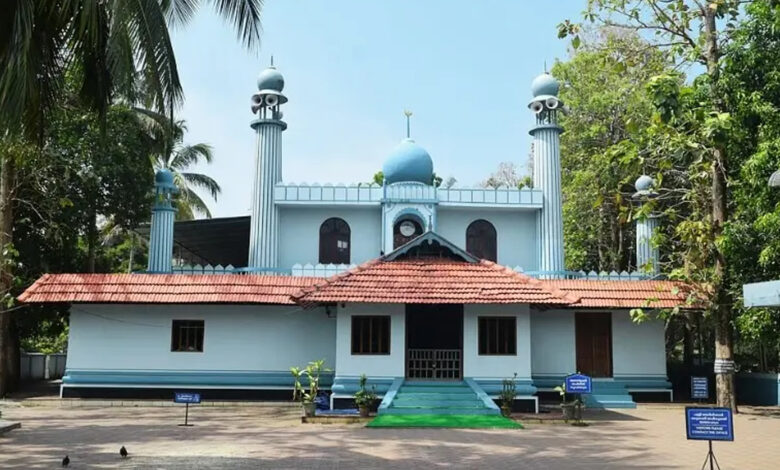
The construction of the first mosque in India marks one of the most significant and faith-inspiring chapters in the universal history of Islam. Known today as the Cheraman Juma Mosque, it is located in the historic city of Kodungallur, Kerala, and is regarded as one of the earliest and most important symbols of Islam’s arrival in the subcontinent.
According to historical traditions, the mosque was built in 629 CE during the lifetime of Prophet Muhammad, giving it a unique and unparalleled significance in the Muslim world. Local Islamic traditions and historical sources link the mosque’s construction to the conversion of the then-ruler, Cheraman Perumal, to Islam.


Legend has it that Cheraman Perumal witnessed the miraculous splitting of the moon (Shaqq al-Qamar) and, upon consulting Arab traders, learned it was a sign of the last Prophet ﷺ. Inspired, he traveled to Arabia, embraced Islam, and, before returning, instructed that a mosque be built in his region.
The mosque’s establishment and the spread of Islam in Kerala were notably influenced by the renowned Tabi‘een scholar Malik bin Dinar, who came from Arabia to propagate Islam along the Kerala coast and played a role in founding several mosques. Some accounts mention that Cheraman Perumal passed away during his stay in Mecca, having sent letters instructing local rulers to respect Malik bin Dinar and allow mosque construction. These letters eventually facilitated the construction of the first mosque in Kodungallur. Malik bin Dinar later established other mosques across Kerala. Some traditions cite Oman’s Dhofar region as the place of Cheraman Perumal’s death.
Historical references to the mosque appear in works such as Imam Ibn Hajar al-Asqalani’s *Al-Isabah fi Tamyiz al-Sahabah*, Sheikh Zainuddin Makhdum’s *Tuhfat al-Mujahideen*, and British historian William Logan’s *Malabar Manual*. While modern historians often classify these accounts as local or traditional narratives, they highlight the mosque’s historical importance.
Kodungallur, historically located near the great port of Muziris, was a major hub of global trade. Arab traders had been visiting the region for centuries, spreading the message of Islam alongside commerce through their ethical conduct and interactions. This helped Kerala become the first region in India to embrace Islam locally.
The Cheraman Juma Mosque has stood continuously since its construction, undergoing repairs and expansions over centuries. Notably, during the 1980s and 1990s, domes and minarets were added, while the 2022 restoration aimed to preserve its original historical structure. The Kerala government has undertaken preservation under the Muziris Heritage Project to safeguard this invaluable Islamic heritage for future generations.
Kerala’s Muslims, historically known as Mappilas, have played a key role in the region’s trade, culture, and social development. Their roots trace directly to the early Arab traders and scholars who arrived during or shortly after the Prophet’s ﷺ lifetime. This makes Kerala’s Islamic traditions among the oldest in the Indian subcontinent.
The Cheraman Juma Mosque today stands not only as a place of worship but also as a symbol of religious tolerance and harmony. Local traditions note that during Ramadan, people from different faiths participate in Iftar arrangements, reflecting the mosque’s role in promoting peace, respect, and communal unity.
As a living monument, the mosque continues to host regular prayers and attracts visitors from various backgrounds who come to appreciate its historical, cultural, and spiritual significance. Its legacy demonstrates that Islam reached distant lands with universal values of faith, learning, and coexistence from the very beginning.
Historical references such as *Tuhfat al-Mujahideen*, *Al-Isabah fi Tamyiz al-Sahabah*, *Malabar Manual*, *History of Kerala*, and official archaeological records all underscore the mosque’s and Kerala’s role in the early history of Islam in the subcontinent, connecting the region closely to the Prophet ﷺ’s era.