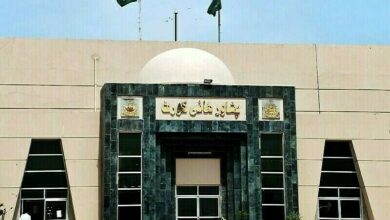
Supreme Court Hears Intra-Court Appeal on Military Trials of Civilians

Islamabad:A seven-member constitutional bench of the Supreme Court, led by Justice Aminuddin Khan, is hearing an intra-court appeal against the decision of military trials of civilians. The bench includes Justices Jamal Mandokhail, Muhammad Ali Mazhar, Hassan Azhar Rizvi, Musarat Hilali, Naeem Akhtar Afghan, and Shahid Bilal Hassan.
In today’s proceedings, the counsel for the Ministry of Defense, Khawaja Haris, presented arguments stating that the Army Act and its rules ensure a fair trial process. Justice Jamal Mandokhail raised a query about differing opinions from Justices Muneeb, Ayesha, and Afridi on military trials, asking which judgment Khawaja Haris agreed with.
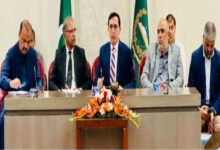

Khawaja Haris responded by stating that he did not agree with any of those judgments. He further clarified that Justice Ayesha Malik had deemed Section 2(1)(d)(i) of the Army Act contrary to fair trial principles, while Justice Afridi had refrained from commenting on the legal sections, deferring to larger bench rulings.
Justice Mandokhail pointed out that the majority of judges had upheld the 21st Amendment, including the validity of military trials. Khawaja Haris emphasized that in the case of Liaquat Hussain, a nine-judge bench had affirmed the military trials in the FB Ali case.
Further discussion focused on the legality of military trials, particularly in the context of the 9 May events, with Khawaja Haris arguing that attacking state property was not a political activity. The court raised concerns regarding the military trial’s jurisdiction over civilian matters, specifically noting that the 21st Constitutional Amendment had made clear that cases involving political parties would not be tried in military courts.
Justice Azhar Rizvi raised a point regarding the severity of the 9 May incidents, noting the widespread attacks on military installations and state properties, such as the Lahore Corps Commander’s house. He suggested the scale of the attacks warranted legal action beyond typical political activity.
Justice Mandokhail questioned why military trials were not invoked for attacks on the Parliament building, considering its supreme status in the country’s political hierarchy. The broader issue remains whether the legal processes regarding military courts and their jurisdiction over civilians should continue or be revised.
The proceedings continue as the court considers these pivotal constitutional and legal issues surrounding military trials of civilians and the scope of the Army Act in these cases.