‘Mecca Defense Pact’: How Will Pakistan, Saudi Arabia and Türkiye Support Each Other?
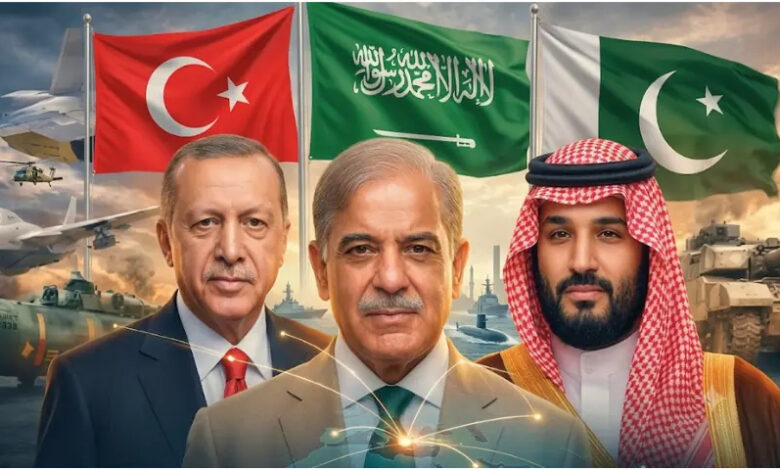
ISLAMABAD: Amid major geopolitical shifts in the Middle East following the US-Israeli war against Iran, Pakistan, Saudi Arabia and Türkiye have taken what is being described as a historic step by signing a joint defence agreement in Makkah.
The agreement, referred to as the “Mecca Joint Defence Agreement,” aims to strengthen collective defence against potential aggression. A key provision states that an armed attack against any one of the three countries would be considered an attack against all three.


The agreement comes at a time when several countries in the region have expressed growing doubts about long-term reliance on US security guarantees and have been exploring alternative security partnerships.
A Major Military Partnership
The three countries bring significant military manpower and capabilities to the alliance. Their combined military personnel reportedly exceed 3.1 million, including active-duty forces, reserves and paramilitary personnel.
Pakistan has the largest manpower contribution, with around 1.71 million personnel, followed by Türkiye with approximately 1.01 million and Saudi Arabia with around 397,000 personnel.
The alliance also has considerable air power. Pakistan, Türkiye and Saudi Arabia collectively operate around 3,415 military aircraft, including approximately 1,397 belonging to Pakistan, 1,101 to Türkiye and 917 to Saudi Arabia.
On the naval front, the three countries have a combined fleet of around 344 vessels, including 38 frigates. Türkiye operates 17 frigates, Saudi Arabia 12 and Pakistan 9.
سعودیها باید بدانند که توافق کاغذی با ترکیه و پاکستان برای آنها امنیتآور نیست، همانطور که سالها شیردهی یکطرفه به آمریکاییها برایشان امنیت نیاورد. سیاستهایتان را اصلاح کنید تا نیاز نباشد از دیگران #گدایی_امنیت کنید.
— ابراهیم رضایی (@EbrahimRezaei14) August 7, 2026
For undersea warfare, Türkiye has around 14 submarines, while Pakistan operates approximately 8. Saudi Arabia currently does not operate submarines.
The three countries also possess a substantial land-based military arsenal, including approximately 6,046 tanks. Pakistan has around 2,677 tanks, Türkiye 2,284 and Saudi Arabia 1,085.
Their artillery capabilities include approximately 2,087 self-propelled artillery systems, 3,821 towed artillery pieces and 1,216 multiple-launch rocket systems.
Strong Financial and Strategic Foundations
The combined annual defence spending of the three countries is estimated at around $124.5 billion.
Saudi Arabia accounts for the largest share, with an estimated defence budget of $64 billion, followed by Türkiye at around $51.4 billion and Pakistan at approximately $10 billion.
One of the alliance’s most significant strategic advantages is Pakistan’s nuclear capability. Pakistan is the only nuclear-armed state among the three countries and is estimated to possess more than 190 nuclear warheads.
Analysts note that publicly available figures may not fully reflect the actual military capabilities of the three countries.
A New Balance of Power in the Region
Experts have described the agreement as more than a symbolic arrangement, arguing that it could contribute to a new balance of power in the Middle East.
Kristian Coates Ulrichsen, a fellow at Rice University’s Baker Institute, said regional countries had been questioning the sustainability of the US security partnership for more than a decade.
Speaking to Al Jazeera, he argued that US military operations against Iran and the subsequent war had intensified these concerns, prompting regional states to diversify their security relationships. However, he said the new defence agreements were not necessarily intended to replace the United States, but rather to provide additional strategic and policy options.
Sina Toossi, an analyst at the Center for International Policy, described the pact as a major geopolitical signal that the US-Israeli war against Iran was reshaping the regional order.
He said Saudi Arabia was expanding its network of security partners rather than relying entirely on Washington.
International Crisis Group analyst Yasmin Farouk stressed that the agreement should not be interpreted as a direct confrontation with Iran, noting that all three countries have historically advocated de-escalation and mediation.
According to Farouk, the common objective is to avoid further escalation in the region. She described the agreement as a means of establishing strategic deterrence and promoting long-term cooperation.
Pakistan’s Role
Michael Kugelman, a senior fellow for South Asia at the Atlantic Council, said the agreement could give Pakistan a more prominent role in the emerging security architecture of the Middle East.
He noted that the pact could enhance Pakistan’s strategic importance and influence as a Muslim-majority country with nuclear capabilities.
Türkiye also brings significant defence-industrial expertise to the partnership. Özgür Ünlühisarcıklı, director of the German Marshall Fund, said the three countries possess complementary strengths, with Türkiye contributing defence-industrial capabilities, Saudi Arabia providing financial resources, and Pakistan bringing military experience and strategic deterrence.
Iran Raises Objections
The agreement has also drawn criticism from Iran.
Iranian senior parliamentarian Ebrahim Rezaei criticised the pact on X, arguing that an agreement signed on paper with Türkiye and Pakistan would not necessarily provide Saudi Arabia with security.
He also criticised Riyadh’s previous reliance on the United States, urging Saudi Arabia to reconsider its policies rather than seeking security from other countries.
Meanwhile, neither Israel nor the United States has issued an official comment on the agreement so far. Israeli officials have previously viewed similar regional alliances with concern.
Questions Over Implementation
Despite the strategic significance of the agreement, questions remain over how it would operate in practice.
It is still unclear whether Pakistan, Saudi Arabia and Türkiye would directly enter a war if one of the three countries came under attack, or what specific military mechanisms would be activated under the collective-defence provision.
Nevertheless, the agreement could serve as a significant deterrent by signalling that aggression against one member could potentially trigger a coordinated response from all three.
The pact therefore represents a major development in regional security cooperation and could significantly increase the strategic cost of any potential aggression against the three countries.