Pakistan Signs $4.6 Billion Defense Deal with Libya’s Eastern LNA
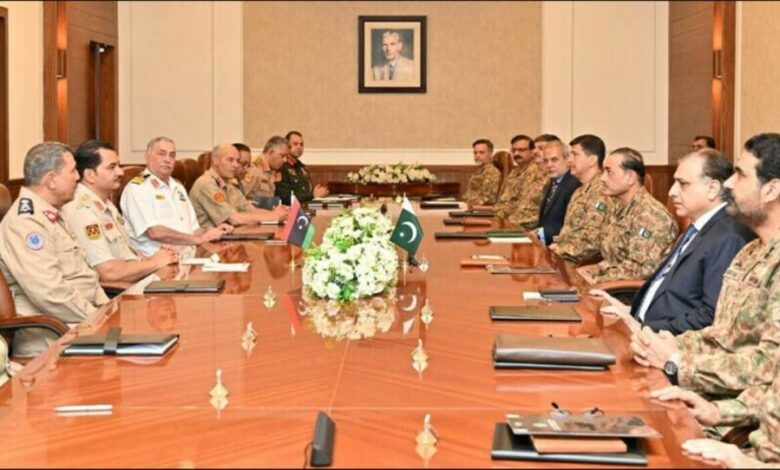
Karachi: Pakistan has finalized a major defense agreement worth over $4 billion with Libya’s Eastern Force, the Libyan National Army (LNA), according to four Pakistani officials speaking to Reuters on condition of anonymity due to the sensitive nature of the deal.
The agreement was finalized last week in Benghazi, Eastern Libya, following a meeting between Pakistan’s Army Chief, Field Marshal Asim Munir, and LNA Deputy Commander-in-Chief, Saddam Khalifa Haftar. It is being described as one of Pakistan’s largest arms deals in history. Pakistan’s Ministry of Foreign Affairs, Ministry of Defence, and military spokespersons have not commented on the agreement.

Libya has remained politically unstable and divided since the NATO-backed uprising in 2011 that ended Muammar Gaddafi’s rule. According to a draft of the deal, the contract includes the sale of 16 JF-17 multi-role fighter aircraft, jointly produced by Pakistan and China, along with 12 Super Mushak trainer aircraft for basic pilot training. Pakistani officials confirmed the accuracy of this list but noted that final numbers may change.
Another official stated that the deal encompasses land, naval, and air equipment, with implementation expected over approximately two and a half years. While two officials estimated the deal’s value at over $4 billion, two others suggested it could reach up to $4.6 billion.
The LNA’s official media channel announced on Sunday that the force had entered a defense cooperation agreement with Pakistan, covering arms trade, joint training, and military production. Saddam Haftar told Al Arabiya Al Hadath TV that a new phase of strategic military cooperation with Pakistan had begun.
The UN-recognized Government of National Unity, led by Prime Minister Abdul Hamid Dbeibah, controls most of western Libya, while Haftar’s LNA holds eastern and southern regions, including major oil fields, and does not recognize the western government. A UN arms embargo on Libya has been in place since 2011, requiring approval for any arms transfers. A December 2024 UN expert panel report noted that the embargo had become largely ineffective, with several foreign states openly providing military support to both sides.
It remains unclear whether Pakistan or Libya has obtained any UN exemptions for this deal. However, three Pakistani officials stated that the agreement does not violate the UN embargo. One official noted that Pakistan is not the only country entering into defense agreements with Libya, while another said Haftar faces no direct sanctions. A third official mentioned improving relations between eastern Libya and Western countries, driven in part by rising oil exports.
In recent years, Pakistan has sought to expand its defense exports, leveraging its experience in counterterrorism and domestic defense industries, including aircraft, armored vehicles, weapons, ammunition, and naval construction. Islamabad also highlighted its air force’s performance during the May clashes with India.
Field Marshal Asim Munir told Al Arabiya Al Hadath that the recent conflict with India demonstrated Pakistan’s modern military capabilities globally. Pakistan is marketing the JF-17 as a cost-effective, versatile fighter jet and positioning itself as a country capable of providing complete training, maintenance, and defense packages independent of Western supply chains.
Additionally, Pakistan has strengthened security relations with Gulf countries, including a strategic mutual defense agreement with Saudi Arabia in September 2025 and high-level defense talks with Qatar. The Libya deal is expected to enhance Pakistan’s influence in North Africa, where global and regional powers are seeking a role in Libya’s divided security landscape and oil-based economy.