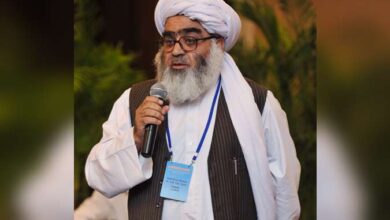
Pakistan Run Like an Estate of the Establishment; Presidents and PMs Act as Clerks, Says Maulana Muhammad Khan Sherani

Karachi/Quetta (Daily Qudrat) — Veteran religious scholar and leader of Jamiat, Maulana Muhammad Khan Sherani, has said that following the fall of the Ottoman Caliphate, the Muslim world has suffered from a lack of collective governance and legal unity, and today Muslims stand not as conquerors but as a conquered nation. He expressed these views while addressing the “Awareness and Enlightenment Gathering” organized by Jamiat Talaba Islam Pakistan at Jamia Darul Uloom Islamia, Water Pump, Karachi.
Maulana Sherani said that the region comprising Pakistan was once a conquered territory of the British, and Pakistan remains a member of the British Commonwealth, led by the British royal family. Commenting on the current political landscape, he said Pakistan resembles an “international checkpoint” rented out by Britain, where clerics’ edicts, politicians’ deception, generals’ use of the military, and media propaganda are all available “for hire.”
He further stated that Pakistan exists as a country in name only, and in reality functions as an estate controlled by the establishment created by the East India Company. He asserted that the president, prime minister, governors, and parliament function like clerks and assistants to a feudal lord, responsible only for collecting revenues from the public and presenting them to the real masters. He added that while the establishment can question elected leaders about their wealth, no one can question the establishment itself because it considers itself the absolute owner.
Sherani claimed the country operates as a “military outpost for Western powers,” arguing that such outposts benefit by portraying the region as unstable and conflict-prone to justify their strategic presence.
Addressing the gathering, Maulana Gul Naseeb Khan said that people have repeatedly been pushed into conflict in the name of religion, and religion has been used as a weapon, whereas global conflicts are fundamentally about power, control, and resources—not faith. He said unity through shared values brings peace, while amplifying differences fuels discord.
Other speakers including Noor Ahmed Sindhi, Maulana Mahmood-ul-Husseini, Mufti Saleem Shah, and Muhammad Nawaz Azad also addressed the event.