Pakistan and Iran Set Ambitious Trade Target of $8 Billion Annually
Trade Ministers Discuss Strengthening Bilateral Economic Relations
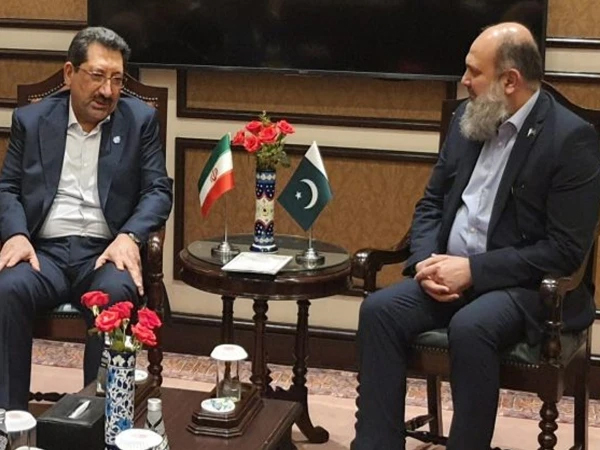
Islamabad: Pakistan and Iran have agreed to further enhance their bilateral economic cooperation by expanding trade, border relations, and mutual trust-based partnerships. This development emerged during a meeting between Pakistan’s Federal Minister for Commerce, Jam Kamal Khan, and Iran’s Minister for Industry, Mines, and Trade, Mohammad Atabak, in Islamabad. The meeting took place during the two-day official visit of Iranian President Masoud Pezeshkian to Pakistan.
In high-level discussions, both ministers emphasized the importance of boosting trade, eliminating border barriers, and exploring new avenues for trustworthy cooperation in priority sectors. Iranian Minister Mohammad Atabak praised the proactive role of Pakistan’s government and Ministry of Commerce, acknowledging that without the immediate and earnest efforts of the team, this progress would not have been possible. He stressed the need to structure this advancement into an efficient and results-driven trading framework.
Federal Minister Jam Kamal Khan echoed the sentiment, stating, “There is a time in diplomacy when the iron is hot, and now is that moment. We must act immediately because delay only complicates matters further.” He underscored that after political will and determination, formal steps would follow, with Pakistan ready to strengthen economic ties with Iran through mechanisms such as the Joint Economic Commission (JEC), Business-to-Business (B2B) meetings, and sector-specific trade delegations.
Both ministers identified key areas for collaboration, including agriculture, livestock, services, energy, and cross-border logistics. Minister Kamal Khan suggested forming focused trade delegations, comprising representatives from both federal and provincial chambers of commerce, to facilitate detailed discussions on market access and regulations. He noted that this model had been successfully implemented in countries like Belarus and should also be tested with Iran in the most promising sectors.
They also agreed on maximizing the use of existing trade corridors and border facilities. Jam Kamal Khan highlighted the importance of regional trade, citing how ASEAN countries achieved growth through cross-border trade with their neighbors. He emphasized that Pakistan and Iran should leverage their geographical proximity for mutual benefit, warning that missing this opportunity would lead to both time and cost losses.
Looking ahead, Minister Kamal Khan projected that if both countries fully utilized their potential, bilateral trade could rise to \$5-8 billion annually in the coming years. He further stated that Pakistan and Iran’s trade partnership could expand into a powerful regional trade bloc encompassing Turkey, Central Asia, Russia, and the Middle East.
Iranian Minister Mohammad Atabak supported the idea of dedicating a special Business-to-Business (B2B) day during each high-level visit and expressed his readiness to bring Iranian business delegations to Pakistan. He also mentioned ongoing negotiations to boost Pakistani exports and urged both governments to ensure the swift implementation of new agreements. He stressed that the traders and industrialists in both countries are ready and trust one another, but they now need a clear and consistent facilitation system.
The two ministers also emphasized the cultural and linguistic harmony between the people of Pakistan and Iran as the foundation of their bilateral relations. Jam Kamal Khan referred to a recent meeting with the CEO of a Special Economic Free Zone, where he communicated in the Balochi language, reflecting the deep ties between the two nations. He stressed that this is not just about trade but also about people-to-people relations, with trust and familiarity among traders forming the strongest basis for sustainable economic integration.
The ministers agreed to expedite the upcoming session of the Pakistan-Iran Joint Economic Commission, ensure the involvement of both public and private sectors, and prioritize border cooperation and trade logistics.
The overarching message of the meeting was clear: **”Now is the time for action.”** With high political alignment and mutual trust, Pakistan and Iran are set to enter a new phase of strategic economic partnership, which could reshape the trade landscape of the entire region.