National Party President Dr. Abdul Malik Baloch Rejects Closure of Language Departments at Balochistan University
Quetta:Dr. Abdul Malik Baloch, the central president of the National Party and a member of the Provincial Assembly, has strongly opposed the Balochistan government’s decision to shut down the departments of Balochi, Brahui, and Pashto at the University of Balochistan. The government has instead issued directives for the establishment of the “Institute for Literature and Languages,” a move that Dr. Baloch and his party have categorically rejected. He stated that the National Party will launch every possible democratic struggle to protect the language departments.
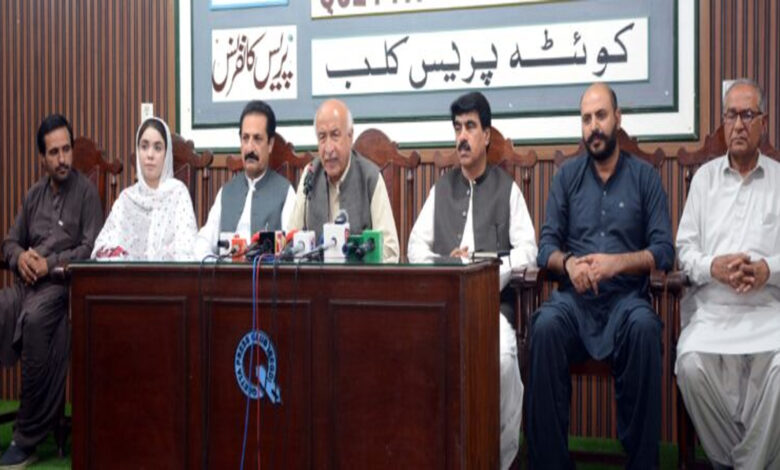
Addressing a press conference at the Quetta Press Club on Wednesday, Dr. Baloch emphasized that the closure of these language departments would have severe consequences for Balochistan’s cultural and linguistic heritage. He was accompanied by other members of the Balochistan Assembly, including Khair Jan Baloch, Kulsoom Niaz, Provincial President Mir Aslam Baloch, and Ali Ahmad Langoo.
Dr. Baloch criticized the government’s decision to close the language departments, arguing that they were wrongly deemed “unprofitable” due to a lack of students. He reminded the government that universities are not solely for generating income, but for producing skilled human resources. He pointed out that some of the best human resources in Balochistan have emerged from the University of Balochistan and Balochistan Medical College (BMC).
He also highlighted the increase in university fees, which he claimed has caused a significant drop in student enrollment—from 16,000 to only 6,000. “The government should have increased this number to 60,000 instead of raising fees,” Dr. Baloch stated. He further criticized the government’s failure to pay university faculty members their salaries for three months, and its decision to slash professors’ salaries by up to 1 lakh rupees.
The National Party leader raised concerns about the mismanagement of funds in the province, stating that the Balochistan government had allocated 23 billion rupees to deputy commissioners for various projects, despite a clear ruling by the Balochistan High Court stating that deputy commissioners should not be project directors. Dr. Baloch argued that these funds should have been used to create an endowment fund for the universities, ensuring that faculty salaries and university operations could be sustained.
Dr. Baloch called for the creation of 200 to 300 new positions in the language departments each year, which would attract thousands of students to these critical areas of study. He also referenced the growing global recognition of Balochi language education, citing that Balochi is even being taught in Sweden, while the provincial government seeks to close the department.
In a passionate appeal, Dr. Baloch stated, “I urge the government of Balochistan and the authorities in Islamabad to reconsider this decision. In the 21st century, nations assert their rights. If this decision is not reversed, the National Party will continue to fight for the preservation of these language departments through democratic means.”
He also questioned the government’s priorities, pointing out that unnecessary expenditures on roads and solar projects should be redirected to complete important projects such as the Jhalawan Medical College, which remains stalled. Dr. Baloch concluded by calling for an increase in the education budget, more scholarships for students, and the revitalization of technical education institutions in the province.
Responding to a question, he noted that the federal government had failed to transfer assets from federal departments to the provinces after the 18th Amendment, which had led to the inability to establish a Provincial Higher Education Commission (HEC). He added that the federal government had also burdened Balochistan with the responsibility of 8,000 Lady Health Workers (LHWs) and 5,000 teachers under the “Aghaz-e-Haqooq-e-Balochistan” program, which the province had shouldered despite the lack of resources.
Dr. Baloch emphasized the importance of preserving language departments, drawing a comparison with Sindh’s “Sindhology” department, one of the largest in the country. He argued that if the government intends to merge three language departments into one, it would make more sense to dissolve the entire university.
He also recalled that during his tenure, the government had introduced mother tongue education at the primary level, a move he proudly associated with his administration’s legacy.