Finance Minister Senator Muhammad Aurangzeb Unveils Pakistan’s Economic Survey for the Current Fiscal Year
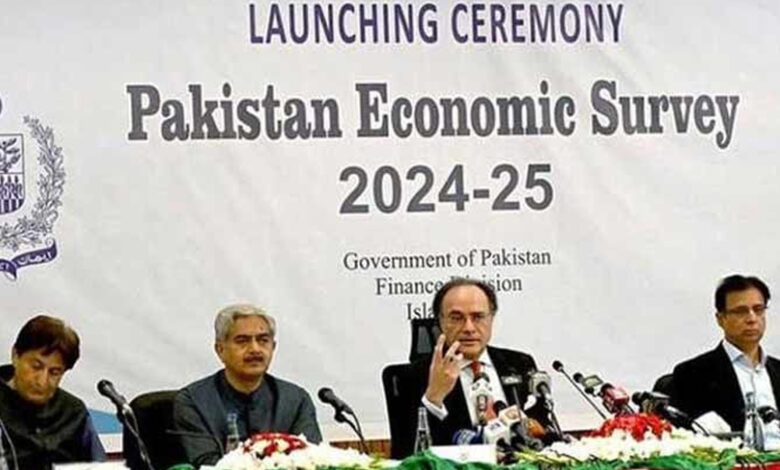
Finance Minister Senator Muhammad Aurangzeb has released the National Economic Survey, offering an overview of Pakistan’s economic performance in the current fiscal year. According to the Minister, the country is progressing towards economic stability with a projected GDP growth of 2.7% and an inflation rate of 4.6% for the year.
Senator Aurangzeb highlighted the significant drop in the policy rate, which had been at 22% last year, and is now reduced to 11%. He also credited Pakistan’s confidence restoration to the International Monetary Fund (IMF) program and praised Prime Minister Shehbaz Sharif for securing the SBA (Stand-By Arrangement) program. He further appreciated the caretaker Finance Minister for ensuring the program remained on track.

The Finance Minister emphasized the need for reforms to transform Pakistan’s economic structure, particularly focusing on improving the tax-to-GDP ratio, which is now at its highest in five years. Reforms at the Federal Board of Revenue (FBR) have also been introduced to improve tax collection efficiency.
**Key Economic Indicators:**
* **GDP Growth:** 2.7%
* **Inflation Rate:** 4.6%
* **Policy Rate:** Reduced from 22% to 11%
* **Foreign Exchange Reserves:** Significant increase
* **Tax Revenue:** 25.8% increase
* **Non-Tax Revenue:** 68% increase
**Agricultural Performance:**
Senator Aurangzeb shared the results of the agricultural sector, noting a decline in the production of major crops. Cotton production fell by 30%, wheat by 8.9%, and sugarcane by 3.9%. However, there was a 15.9% increase in onion production and a 11.5% increase in potatoes. Overall, there was a 13.49% decrease in the production of key crops.
**Sectoral Growth:**
* **Large-Scale Manufacturing (LSM):** Growth rate decreased to 1.5%
* **Textiles:** Showed positive growth of 2.2%
* **Construction Sector:** Growth slowed to 1.3% from 3% in the previous year
* **Petroleum Products:** Growth rate at 4.5%
* **Chemicals:** Growth slowed to 5.5%
* **Mining and Excavation:** Growth decreased to 3.4%
**Social and Educational Progress:**
The survey highlighted that during the July-March period, Pakistan spent 0.8% of its GDP on education. A total of 61.1 billion rupees have been allocated for higher education. The literacy rate in Pakistan stands at 60.6%, with male literacy at 68% and female literacy at 52.8%. The number of primary school enrollments reached 24.83 million.
The report also noted that Pakistan currently has 269 universities, including 160 public and 109 private institutions. Under the skill development program, over 60,000 youth have been trained in fields such as IT, agriculture, mining, and construction.
**Climate and Environmental Concerns:**
The survey also touched on the environmental challenges Pakistan faces, reporting that global greenhouse gas emissions have a minimal contribution from Pakistan (less than 1%). The devastating floods in 2024 affected 33 million people and caused a loss of \$15 billion. The report mentioned a 31% increase in rainfall in 2024 and noted the country’s average temperature for the year was 23.52°C.
**Fiscal Deficit and Debt:**
According to the survey, Pakistan’s total income stood at 13.37 trillion rupees, with a 25.8% increase in tax revenue. The fiscal deficit was recorded at 2.6%, while the primary surplus was 3%. The country’s total debt surpassed 76 trillion rupees, with domestic debt reaching 51.5 trillion rupees and external debt at 24.5 trillion rupees.
**Outlook:**
Senator Aurangzeb concluded by expressing optimism about the direction in which the country’s economy is moving. He acknowledged that Pakistan’s recent IMF installment faced difficulties due to pressures from the Indian Executive Director at the IMF, but affirmed that the international financial body continues to support Pakistan.
The government is focused on promoting local resources, with a target to drive growth in the construction sector and increase manufacturing capacity. The Finance Minister emphasized that Pakistan must continue its efforts to ensure macroeconomic stability and growth.
### Will the government’s economic strategies be enough to achieve sustainable growth in the coming years?