Scientists Discover Two Gigantic Structures Hidden Deep Within Earth
Islamabad (Qudrat Daily) – Scientists have uncovered significant secrets about a mysterious and complex world beneath the Earth’s surface. According to experts, reaching the Earth’s inner depths is far more challenging than traveling to distant regions of space, which is why humanity remains largely unfamiliar with the hidden realities beneath our own planet.
While spacecraft have traveled nearly 25 billion kilometers into space, human drilling has only penetrated about 12 kilometers into the Earth. This limited access has kept the processes occurring within the Earth’s layers a long-standing enigma.


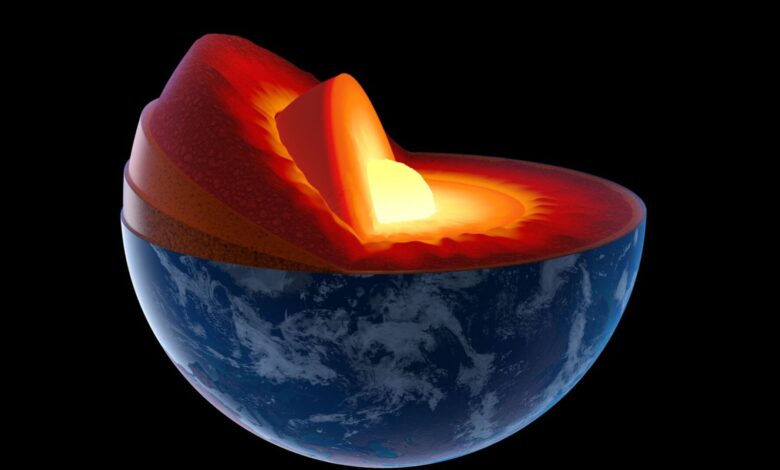
A recent study published in the scientific journal *Nature Geoscience* reveals evidence of two unusually large, intensely hot rock formations beneath the Earth. These structures are located near the boundary between the Earth’s upper and lower layers, where the outer section consists of molten metal and the inner part is composed of solid metals. The inner layer lies roughly 4,800 kilometers beneath the Earth’s surface and is estimated to be about 70 percent the size of the Moon.
The research indicates that these colossal hot rock structures are found beneath Africa and the Pacific Ocean at a depth of approximately 2,900 kilometers. Scientists believe these solid yet extremely hot rocks have played a crucial role in maintaining Earth’s magnetic field for hundreds of millions, even billions, of years.
Direct observation at such depths is virtually impossible, so researchers relied on advanced computer modeling and ancient paleomagnetic data. Through these simulations, they reconstructed Earth’s ancient magnetic fields and analyzed changes occurring over the last 260 million years.
The findings reveal that temperatures along the inner layer boundary are not uniform; some areas beneath these massive rock structures, roughly the size of continents, are unusually hot. The study also shows that certain parts of Earth’s magnetic field have remained relatively stable for millions of years, while others have changed dramatically over time.
Scientists say these discoveries highlight the complex distribution of heat in the deep Earth, offering new insights into the planet’s internal structure, the evolution of its magnetic field, and long-term geological processes.