Maulana Fazlur Rehman Questions Imran Khan’s Imprisonment, Opposes Politicians’ Detention and Restrictions
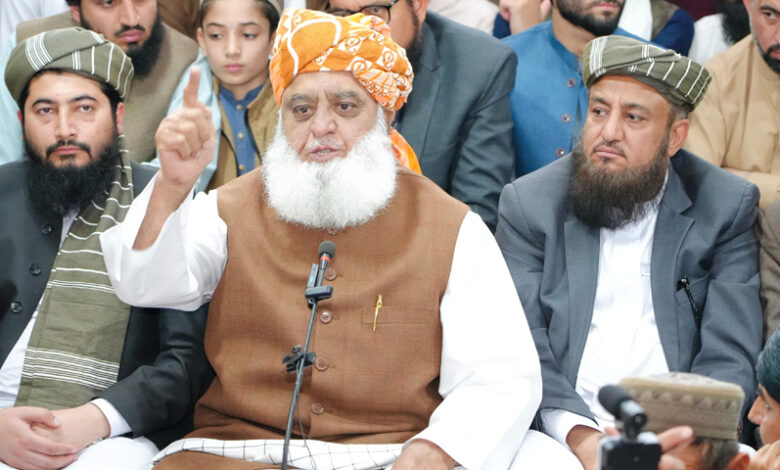
Chakwal: Jamiat Ulema-e-Islam (JUI) chief Maulana Fazlur Rehman has questioned the imprisonment of former Prime Minister Imran Khan and stated that he does not support the detention of any politician or restrictions on meeting them. He emphasized that the key question remains: why is Imran Khan in jail?
Speaking to the media in Chakwal, Maulana Fazlur Rehman criticized the rapid pace of constitutional amendments, saying they undermine the sanctity and authority of the Constitution, which he described as a national covenant. He noted that the 26th constitutional amendment involved months of consultation and consensus, whereas the 27th amendment was passed through a forced two-thirds majority, making it controversial and unlikely to be accepted by the public.


He also expressed concern over recent legislation, including laws on child marriage under 18, domestic violence, and gender change, stating that such laws contradict the teachings of the Quran and Sunnah. According to him, these legal changes reflect the influence of the United Nations Charter, while Pakistani lawmakers have sworn to legislate according to Islamic principles.
Maulana Fazlur Rehman announced that an All-Parties Conference of religious groups, schools of thought, and madrasas will be held on December 22 in Karachi to adopt a unified stance on these issues.
Referencing a recent Supreme Court decision, he criticized the reduction of a rape sentence from 20 to 5 years and the reclassification of the crime, calling it contrary to Islamic teachings. He added that current policies provide leniency in cases of zina (adultery) while creating obstacles in lawful marriages, which goes against the concept of an Islamic Republic.
Rehman also criticized the government, claiming it lacks a legitimate mandate and is essentially operating with a “fake mandate,” dominated by the Pakistan Muslim League-N with the Pakistan Peoples Party merely providing support. He warned that unconstitutional legislation would amount to rebellion against the Constitution, nullifying the government’s mandate.
On the potential 28th constitutional amendment and the creation of new provinces, he cited the example of the FATA merger, which he said was forced despite objections and led to the loss of state control in the region. He stressed the importance of careful planning and consideration of ground realities before making such decisions.
Regarding prosecution and institutional flaws, he called for a collective consensus, which he said would be addressed at the upcoming religious leaders’ conference. He described the restrictions on meetings with Imran Khan as unfortunate and reiterated that no democratic country should prevent such interactions.
Concluding his remarks, Maulana Fazlur Rehman said the fundamental question is who truly governs and makes decisions in the country, as citizens are compelled to live under these decisions. He also noted that the new role assumed by the Army Chief should be viewed positively if it emerges from consultations with religious scholars.