Pakistan Rejects India’s Claims on Jammu and Kashmir at UN Security Council
Islamabad: Pakistan has strongly rejected India’s position on Jammu and Kashmir at the United Nations Security Council (UNSC), stating that the disputed territory is neither an integral part of India nor its internal matter. Pakistan also warned that India’s unilateral and irresponsible actions could jeopardize regional peace.
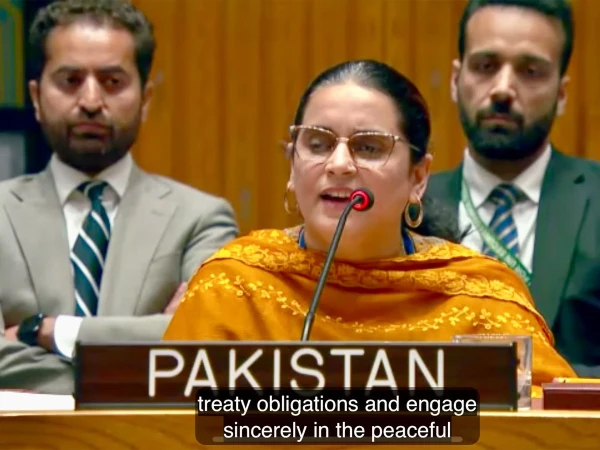
Speaking during the UNSC debate on the peaceful settlement of disputes in the context of Resolution 2788, Counsellor Saima Saleem of Pakistan’s Mission to the United Nations exercised the right of reply to respond to India’s remarks.
She said it was “ironic” for India to preach peace while violating international law and UN Security Council resolutions, engaging in aggression against its neighbors, and allegedly sponsoring terrorism in the region.
Saima Saleem emphasized that Jammu and Kashmir remains an internationally recognized disputed territory and that India’s denial cannot alter its legal status. She noted that India itself had brought the Kashmir issue before the Security Council and is now disregarding the very resolutions related to the dispute.
“UN resolutions do not expire,” she stated, adding that there is a clear distinction between the conditions in Azad Jammu and Kashmir and Indian Illegally Occupied Jammu and Kashmir, where, she alleged, political repression, arbitrary arrests, and human rights violations continue.
The Pakistani diplomat stressed that the Kashmiri people’s inalienable right to self-determination cannot be denied. She also criticized India’s unilateral decision to suspend the Indus Waters Treaty, calling it inconsistent with international law and the principles of the UN Charter.
“The waters of the Indus River are a source of life for Pakistan’s 240 million people, not a weapon of war,” she said, warning that such actions could undermine regional stability.
Saima Saleem described Pakistan as one of the world’s biggest victims of terrorism, citing the sacrifices of thousands of innocent civilians in its fight against the menace. She further alleged that terrorism networks linked to India have expanded beyond the region, referring to the Kulbhushan Jadhav case as evidence.
She also expressed concern over what she described as the rise of Hindutva-inspired extremism in India, alleging that Islamophobia has taken on the character of state policy and that religious minorities face discrimination and repression.
The Pakistani envoy said Pakistan has exercised restraint despite provocations, kept the door open for dialogue, and remained committed to the peaceful resolution of disputes. She maintained that lasting peace in South Asia can only be achieved through adherence to the UN Charter, international law, and UN Security Council resolutions.
Pakistan urged India to implement Resolution 2788 in both letter and spirit, honor its treaty obligations, and play a constructive role in the peaceful resolution of the Jammu and Kashmir dispute.