Mahmood Khan Achakzai Delivers Fiery Speech in National Assembly, Questions Government Failure Over Quetta and Balochistan Attacks
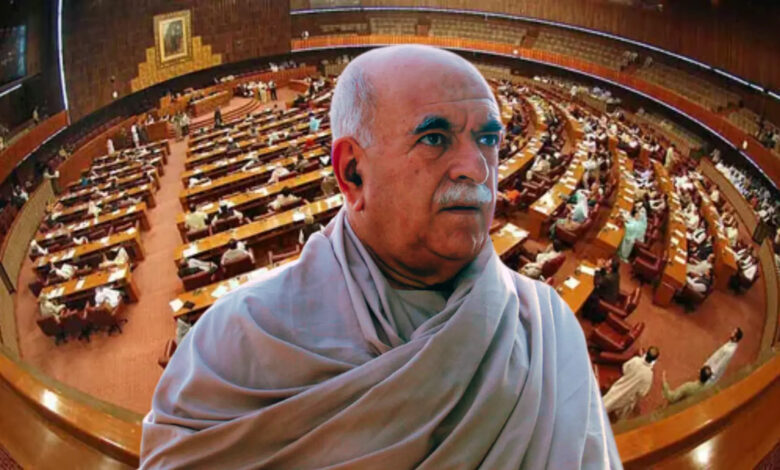
**Islamabad:** Chairman of the Pashtunkhwa Milli Awami Party (PkMAP), head of the Tehreek Tahafuz-e-Aain Pakistan, and Leader of the Opposition in the National Assembly, Mahmood Khan Achakzai, delivered a hard-hitting and emotional speech in the National Assembly, sharply criticizing the government’s handling of recent attacks in Quetta and other parts of Balochistan.
Addressing the House, Achakzai said it was deeply painful to consider that if intelligence agencies had deliberately or negligently ignored the situation, then those institutions were culpable. He added that if the agencies were unaware of the developments, then those responsible should have resigned. Questioning the security lapse, he asked how armed men were able to enter Quetta and operate across 18 districts, freely moving near markets and targeting multiple banks, while others were left untouched.


He strongly criticized what he termed a “fake government,” questioning where it was at the time of the attacks and accusing it of sitting in power only to plunder Quetta and destabilize Pakistan. Addressing the Speaker, Achakzai said such a government should be dissolved, adding that in any responsible system, someone would have resigned over such failures.
Drawing comparisons with international responses to crises, Achakzai recalled the 9/11 attacks in the United States, noting that within minutes, all American television channels declared the country under attack. In contrast, he lamented that during the violence in Quetta, television channels in Pakistan continued airing cricket commentary instead of informing the nation of a terrorist assault. He termed such governance disgraceful.
Achakzai also expressed disappointment over statements attributed to Defence Minister Khawaja Asif, calling the information provided to him about Balochistan inaccurate. He stressed that Balochistan remains a “blind spot” for Pakistan, misunderstood even by scholars and state institutions, including the Foreign Office.
He went on to give a detailed historical account of Balochistan, explaining how British Balochistan was formed in 1886 under Robert Sandeman and how Pashtun and Baloch regions historically remained administratively separate until their merger into a single province in 1970. He argued that the province was formed unnaturally and that past power-sharing arrangements, including a proposed formula of representation among Baloch, Brahui, Pashtuns, and settlers, were ignored, leading to long-term instability.
Highlighting economic injustice, Achakzai pointed out that despite Sui gas being extracted from Balochistan and used across Pakistan and even internationally, local populations in areas such as Marri and Bugti still lack access to gas. He questioned how people could be expected to allow further extraction of minerals when basic rights and benefits were denied to them.
He stressed that Pakistan could only survive through genuine democracy, supremacy of parliament, and granting rightful ownership of resources to the people of each region. He said Pakistan would not truly prosper until Pashtuns, Baloch, Sindhis, Saraikis, and Punjabis all felt empowered and secure. “Pakistan will not survive on slogans alone,” he said, adding that it would only become a strong federation when its constituent nations were respected.
Achakzai also addressed concerns about PTI founder Imran Khan’s health, urging the government to allow his personal doctors to examine him in jail and publicly share accurate medical information to avoid unnecessary speculation and unrest.
Calling for reconciliation and reform, Achakzai urged policymakers to abandon flawed security and political approaches, seek cooperation with neighboring countries including Afghanistan, and focus on economic integration rather than perpetual hostility.
During his speech, the live audio transmission was first muted, and later the video feed of the National Assembly channel was also switched off, drawing further controversy and criticism from opposition members.
His speech underscored growing frustration within opposition ranks over security failures, political marginalization, and what they describe as the erosion of democracy and constitutional governance in the country.