Sympathy or Morality Cannot Replace the Law, Judges Must Decide on Legal Principles: Federal Constitutional Court
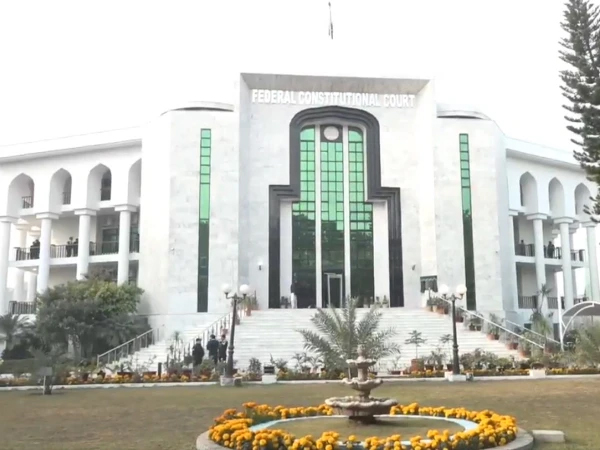
Islamabad: The Federal Constitutional Court has ruled that sympathy or personal morality cannot replace the law, emphasizing that judges must decide cases strictly in accordance with legal principles rather than emotions.
During the hearing, the court stated in its verdict that judicial decisions must be based on law, not on personal feelings, compassion, or moral considerations. Courts, it said, cannot apply standards outside the law on the basis of sympathy or individual notions of fairness.


The court observed that judicial credibility does not lie in emotional decisions but in strict adherence to the law. It added that personal beliefs or political realities cannot form the basis of judicial rulings.
In its decision, the Federal Constitutional Court set aside an earlier order of the Sindh High Court that had allowed a student to appear in a special or super supplementary examination. The court clarified that there is no provision in the law, rules, or regulations permitting such special or super supplementary exams, and therefore high courts cannot issue such directions based on sympathy, equality, or personal sentiments.
The court further stated that judges are required to administer justice impartially and without fear, as Pakistan is a state governed by the Constitution, not by individuals. Judges, it said, are neutral arbiters, not private persons, and giving preference to sympathy over legal duty amounts to a deviation from the judicial role.
The verdict emphasized that high courts themselves are creations of the Constitution and that Pakistan’s constitutional journey has always remained within the framework of law. Personal goodwill or unfettered discretion, the court noted, is not part of the constitutional system.
The court also highlighted that high courts have limited jurisdiction under Article 199 of the Constitution and may exercise only those powers explicitly granted by the Constitution or the law. No judicial forum, the court stressed, has the authority to exceed constitutional limits.
The case involved a student of Shaheed Mohtarma Benazir Bhutto Medical University who was unable to appear in annual examinations due to a kidney transplant and subsequently missed supplementary exams on medical grounds. The student had submitted two applications to the vice chancellor, both of which were rejected by the university administration.
The student later approached the Sindh High Court under Article 199, which allowed him to appear in a special or super supplementary examination. However, the Federal Constitutional Court overturned that decision, ruling that such orders fall outside the scope of the law and the Constitution.
The detailed 18-page written judgment was issued by Justice Aamer Farooq.