PTI Slams DG ISPR’s Remarks, Calls Political Statements Against Imran Khan Undemocratic
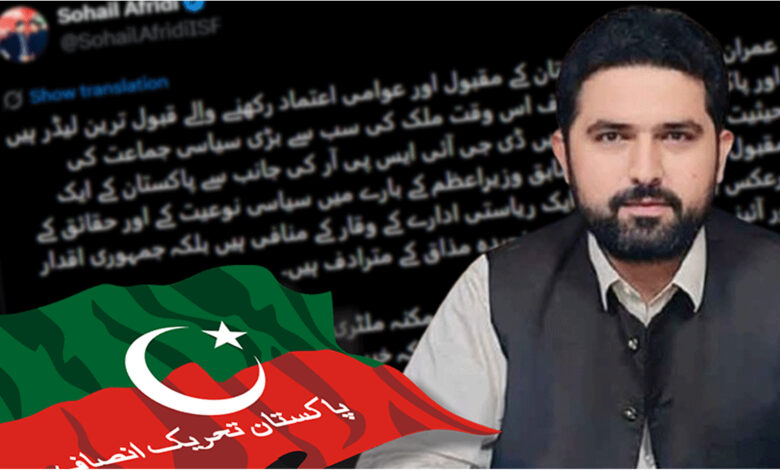
Islamabad:Pakistan Tehreek-e-Insaf (PTI) has expressed serious reservations over the recent statements of the Director General ISPR, stating that politically charged and factually incorrect remarks about a popular political leader and former prime minister not only violate democratic norms but also undermine the dignity of state institutions.
In a statement posted on X, Khyber Pakhtunkhwa Chief Minister Sohail Afridi said that Imran Khan is Pakistan’s most popular leader with strong public trust, while PTI is currently the country’s largest political party. In such a context, he said, political commentary by a spokesperson of a state institution goes against the spirit of the Constitution and democratic principles.
The statement clarified that opposition to any potential military operation is not limited to PTI alone. According to Afridi, all political and religious parties, as well as various schools of thought in Khyber Pakhtunkhwa, agree that military operations are not a sustainable solution to complex issues.
He emphasized that the core problem is not a lack of seriousness in combating terrorism, but flaws in the decision-making process, where ground realities, elected representatives, the provincial government, and local communities are not taken into confidence.
Afridi highlighted that several districts of Khyber Pakhtunkhwa continue to face insecurity, economic stagnation, and the threat of displacement, while businesses, education, and daily life remain severely affected.
He noted that the province has already witnessed 22 major military operations and nearly 14,000 intelligence-based operations, yet terrorism has not been completely eliminated, pointing to weaknesses in policy formulation and implementation.
Questioning past strategies, Afridi asked what guarantee exists that a new military operation would bring lasting peace when previous approaches failed despite heavy human and financial losses. He warned that without transparency, clear objectives, and measurable outcomes, any new initiative could further increase uncertainty.
The statement also recalled that the people of Khyber Pakhtunkhwa have sacrificed nearly 80,000 lives in the war against terrorism. Linking the province’s people or their democratic mandate with terrorism, he said, is deeply regrettable and harmful to national unity.
Afridi added that PTI itself has been a victim of terrorism, with many of its office-bearers, elected representatives, and ministers having laid down their lives. He warned that irresponsible allegations not only fuel hatred but also create dangerous political narratives.
Concluding his statement, Sohail Afridi demanded that instead of unilateral decisions or press conferences, the government should implement a consensus declaration adopted by a national jirga comprising all political and religious parties and schools of thought in the Khyber Pakhtunkhwa Assembly, and ensure that future policy-making is carried out through broad consultation with elected representatives and all stakeholders.