Karachi’s Incomplete Infrastructure and Delayed Development Projects Turn into a Major Ordeal for Citizens
Broken roads, clogged drains, and rising pollution are taking a toll on public health as key projects remain unfinished even at the close of 2025.
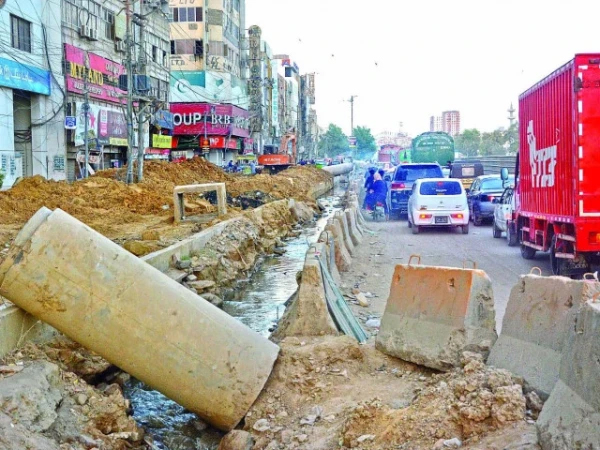
Karachi: As 2025 draws to a close, Karachi’s incomplete infrastructure and delayed development projects continue to pose serious challenges for residents, adversely affecting public health and quality of life. Hollow promises, coupled with broken roads, clogged sewerage systems, and worsening pollution, have led to a noticeable rise in respiratory and other health-related illnesses across the city.
According to reports, a clear gap persists between official claims and on-ground realities in the infrastructure development sector over the past year. The Sindh government has failed to complete several major projects in 2025, including the Bhutto Highway project linking Qayyumabad to the M-9 Motorway. The project was scheduled for completion by December 2025; however, it missed the deadline. During a meeting held in the last week of November, the Sindh Chief Minister was informed that while the highway section from Qayyumabad to Quaidabad had been opened, work up to the M-9 Motorway was only around 65 percent complete.
Similarly, the Sindh government’s land record digitization project has remained unfinished despite years of work. In January 2024, the Board of Revenue informed the caretaker government that revenue records would be digitized and linked with e-registration and e-mutation systems within six months. It was also assured that city survey records across the province would be digitized in the same timeframe. However, the project remains incomplete even in 2025.
In addition, nearly four decades after its launch, the Sindh government has yet to carry out development work on one of Karachi’s major housing schemes, Hawksbay Scheme 42. Initiated in 1984 and spread over 6,000 acres, the project continues to suffer from a lack of basic utilities such as electricity and water, preventing many allottees from constructing their homes. Although the Lyari Development Authority announced in 2025 that it would issue leases to plot holders, the promise has yet to be fulfilled.
Urban planner Dr. Syed Nawaz-ul-Huda stated that the unbalanced approach of both the federal and Sindh governments toward Karachi’s mega projects has persisted for years. He noted that projects related to water supply, sewerage, and mass transit were announced over two decades ago but faced delayed execution, and are now further hindered by bureaucratic obstacles. He emphasized that such projects should ideally be overseen by local government institutions that are directly accountable to the public.
Beyond public dissatisfaction, the slow pace of development has also contributed to a rise in health problems. Head of the ENT Department at Jinnah Hospital, Professor Dr. Abdul Razzaq Dogar, said that incomplete development projects have generated excessive dust, significantly increasing air pollution in Karachi. As a result, cases of flu, allergies, and other respiratory illnesses have risen by 30 to 35 percent.
He added that unfinished projects, damaged roads, and an inefficient sewerage system are major contributors to respiratory issues affecting nearly 90 percent of the city. Blocked sewer lines and a polluted environment allow germs to enter homes, severely impacting children and making healthy living conditions increasingly difficult.
Medical Superintendent of Civil Hospital Karachi, Dr. Khalid Bukhari, also confirmed a surge in patients due to dust and air pollution. He noted that the growing number of patients has increased the hospital’s demand for oxygen. “Karachi’s incomplete infrastructure and prevailing weather conditions are affecting even healthy individuals. When oxygen levels in the body drop, supplemental oxygen becomes necessary to maintain normal levels,” he said.