Two Senior Supreme Court Judges Object to Amendments in Judicial Code of Conduct
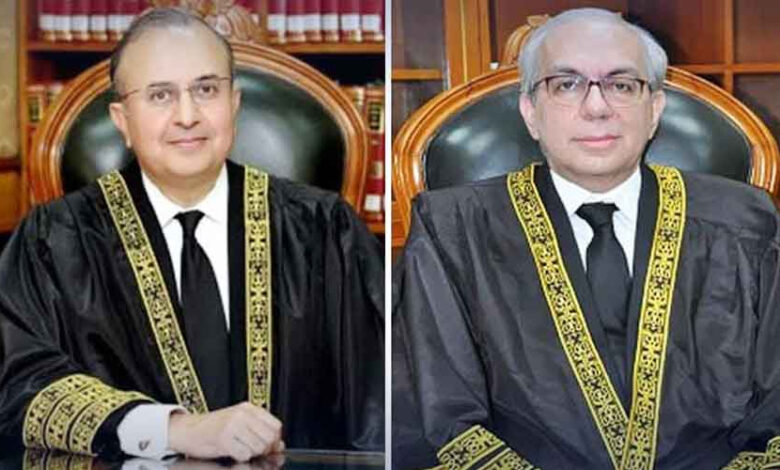
ISLAMABAD: Two senior judges of the Supreme Court of Pakistan, **Justice Mansoor Ali Shah** and **Justice Munib Akhtar**, have raised serious objections to the proposed amendments in the **Code of Conduct for judges**, warning that the changes could **curtail judicial independence**.
In a joint letter addressed to the **Supreme Judicial Council (SJC)**, the judges argued that the **amended rules could not be approved in the council’s current composition**, noting that some members of the **Policy-Making Committee** had already expressed their opinions on the matter beforehand.


They also **objected to the inclusion of Justice Sarfraz Dogar** in the SJC, pointing out that **an appeal related to Justice Dogar’s case is still pending**. The letter stated that the council should have been **reconstituted without him** before taking up the amendments.
The judges warned that **if the proposed changes are adopted**, they would **undermine the judiciary’s independence**, reduce transparency, and **concentrate excessive power in the hands of one individual**. They also noted that the **26th Constitutional Amendment**, which relates to judicial reforms, is still **under challenge before the Supreme Court**, and the **future of two council members** depends on that pending case.
Justice Mansoor and Justice Munib emphasized that the proposed amendments **contradict international judicial norms** and could be used to **silence dissenting judges**. They described the scope of the changes as **vague and potentially dangerous**, warning that they could be exploited to restrict judges who express independent views.
The letter also criticized the **proposed ban on judges speaking to the media**, calling it “unreasonable.” The judges argued that in **modern democratic societies**, members of the judiciary can responsibly discuss **reforms and judicial matters** with the media without compromising impartiality.
They concluded that **a judge can remain neutral while still engaging in responsible public discourse**, stressing that transparency and communication are essential components of a **free and accountable judiciary**.