NFC Meeting Postponed Amid Flood Situation on Sindh’s Request

ISLAMABAD: The federal government has postponed the 11th meeting of the National Finance Commission (NFC) scheduled for Friday, following a request from Sindh due to the ongoing flood crisis.
According to the notification issued by the Ministry of Finance, the meeting—convened by the President of Pakistan—was delayed after several members expressed their inability to attend. Notably, Balochistan’s technical member, Farmanullah, was unavailable due to other commitments.
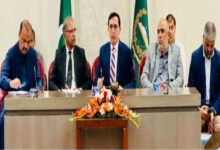

The NFC comprises nine members, including Federal Finance Minister Muhammad Aurangzeb as chairperson, and two representatives from each province: the provincial finance minister and a technical member. However, eight out of nine members conveyed their inability to participate, leading to the postponement. Punjab is represented by Nasir Mahmood Khosa, Sindh by Asad Saeed, and Khyber Pakhtunkhwa by Dr. Musharraf Rasool Cyan.
The session was expected to discuss revenue sharing between the federation and provinces, a matter governed by the 7th NFC Award of 2010, which increased the provinces’ share in the federal divisible pool by 10 percent to 57.5 percent without assigning them additional responsibilities.
This arrangement, however, has significantly increased the federal government’s fiscal burden, particularly in managing debt and budget deficits. Despite repeated commitments, successive governments have avoided cutting expenditures for political reasons, while the FBR has consistently failed to meet its tax-to-GDP targets—falling short of both its own 15 percent goal set in 2015 and the IMF’s 10.6 percent benchmark.
The postponed session was intended for the federal and provincial governments to present their respective financial positions. The Ministry of Finance has also sought assistance from the World Bank in developing five-year macroeconomic projections.
Meanwhile, the IMF recently declared in a report that Pakistan’s economy is expected to stabilize by 2030. However, this assessment has weakened the finance ministry’s case for reducing the provinces’ share.
According to the Planning Commission’s “Udaan Pakistan” program, the country is projected to achieve 6 percent economic growth and significant export expansion, with revenue-to-GDP rising to 16 percent and expenditures limited to 18.8 percent. This trajectory suggests the fiscal deficit could be contained at 2.8 percent of GDP.