National Party’s Workshop Focuses on Political Leadership, Youth Empowerment, and the Situation in Balochistan
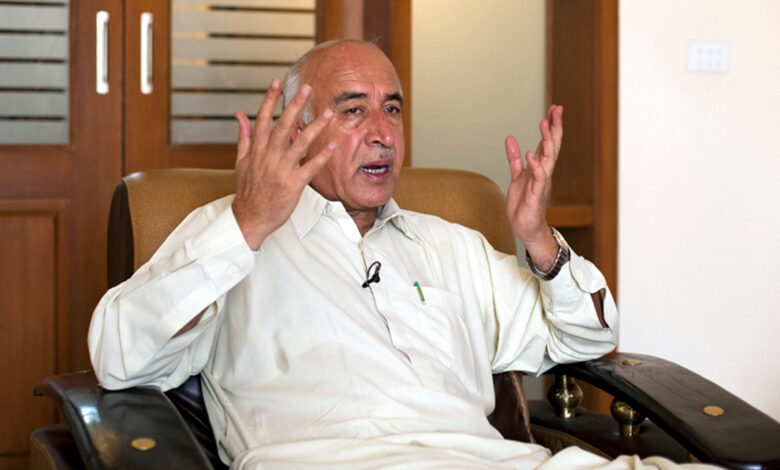
Quetta, Pakistan:The second day of the two-day **National Party (NP)** organizational and political workshop held in Quetta proved to be an intellectually and ideologically significant event. The session featured a lecture by **Professor Dr. Syed Jaffer Ahmed**, a renowned scholar and expert in political science, who discussed the geopolitical situation with a focus on **Pakistan and Balochistan**.
During his address, **Dr. Abdul Malik Baloch**, the Chairman of the **National Party**, emphasized the importance of empowering young political workers and transferring political leadership by nurturing their skills and providing proper political training. He pointed out that 90% of the country’s leadership stems from student organizations, where youth are politically active and receive ideological education. **“The ban on student unions has halted political nurturing and led to a leadership crisis in the country,”** Dr. Malik stated. He further explained that quality political leadership requires commitment, camaraderie, public engagement, hard work, and a strong moral character.
Dr. Malik highlighted that a political worker who remains detached from intellectual and theoretical knowledge will lack wisdom. **“National Party will provide the syllabus of books that every political worker must read,”** he affirmed. He also raised concerns about the widespread violations of human rights, specifically mentioning the mistreatment of **Ghaffar Qamberani** and **Imran Baloch**, along with other detained activists. He described the state’s treatment of nationalist parties, senior bureaucrats, neutral journalists, political students, and professors as **”grossly unjust.”**
Dr. Malik stressed that **organization and discipline** are the cornerstones of success for any political worker. He emphasized that **National Party** encourages **self-criticism, collective decision-making**, and upholding the party’s policy and ideology at all times. He concluded by stating that **Balochistan’s current situation** requires serious introspection, maturity, and vision from political workers, urging them to remain focused on their political duties.
### **Professor Dr. Syed Jaffer Ahmed’s Key Insights**
In his comprehensive lecture on **“Pakistan, Balochistan, and the Regional Situation”**, Professor Dr. Syed Jaffer Ahmed dissected the historical and political factors that shaped the region. He discussed how the **British hasty withdrawal** during the partition of the Indian subcontinent led to an **imperfect formation of Pakistan**, with the lack of a constitution, national consensus, and institutional framework. He criticized the continued colonial-style governance post-independence, citing the **1935 colonial act** that served as Pakistan’s interim constitution, which was insufficient for a fully independent state.
Professor Ahmed elaborated on the **political history of Balochistan**, stating that post-annexation, the federal government ignored the province’s **resources, identity, and autonomy**, which remains a key source of the sense of deprivation felt in the region. He specifically mentioned **Ayub Khan’s Martial Law**, which he referred to as a **“military and civilian bureaucracy joint venture”**, undermining democratic and nationalist struggles.
Dr. Ahmed also discussed the historical struggles of **Bengali nationalist movements**, pointing out how, despite resistance from nationalists, military regimes pushed forward their centralized policies, eventually leading to the breakup of the country. **“The 1973 Constitution is not an ideal constitution,”** he remarked, noting that **Zulfiqar Ali Bhutto** had promised the **removal of the Concurrent List**, but failed to deliver within the stipulated 10 years.
He went on to criticize the central government’s policies and **military intervention**, which has caused **Balochistan’s alienation** from the rest of the country. Dr. Ahmed advocated for **self-determination** as enshrined in **international law**, highlighting that it is not necessary for autonomy to result in secession, but rather it can lead to equitable arrangements ensuring justice and balance.
He further explained the **federal structure of Pakistan**, citing that **the Senate** and **National Finance Commission (NFC) Awards** were meant to maintain equality among provinces, but military regimes under **General Zia and Pervez Musharraf** systematically dismantled these mechanisms, severely undermining the federal framework. **“Balochistan’s underdevelopment cannot be addressed without acknowledging its unique reality,”** Dr. Ahmed asserted.
He concluded by advocating for a **functional and responsive federation** where each region’s unique needs are respected, calling for a comprehensive solution to **Balochistan’s deprivation**.
### **Conclusion of the Workshop**
The workshop concluded with a strong call for **unity, leadership training**, and a reaffirmation of the **National Party’s** commitment to democratic values, human rights, and social justice. The participation of **National Party’s central and provincial leadership** and district representatives reinforced the party’s focus on youth empowerment and political resilience in the region.