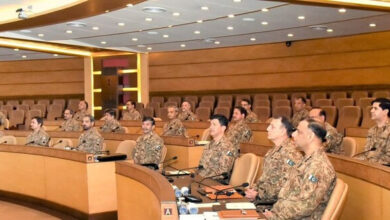
Civilian Trial in Military Courts Case: Defence Lawyer Completes Arguments, Attorney General to Present Next
Islamabad – In the ongoing case regarding civilian trials in military courts, Defence Ministry’s lawyer, Khawaja Haris, has completed his arguments during today’s hearing. The next session will feature the Attorney General presenting their arguments. The case is being heard by a seven-member constitutional bench, led by Justice Ameen Uddin.
The court had directed Khawaja Haris to complete his arguments in today’s session. During the hearing, Justice Hassan Azhar Rizvi raised the question of how “pick and choose” was applied in such cases. In response, Khawaja Haris clarified that the “pick and choose” argument does not apply, emphasizing that each case is considered based on the nature of the crime. He added that cases are referred to either the Anti-Terrorism Court or the Military Court depending on the case’s specifics.


Justice Musarat Hilali remarked whether civilians fall under this category, stating that the focus was on keeping members of the forces disciplined, and clarifying that the rules should only apply to military members. Justice Hassan Azhar Rizvi raised a point, asking about the involvement of civilians if they attack army installations.
Justice Naeem Akhtar Afghan further remarked that the laws were specifically intended for military personnel, and if civilians were to be included under the Army Act, it would have been explicitly mentioned. He pointed out that many provisions of previous constitutions were carried over into the 1973 Constitution, and changes were made during the martial law periods but did not address the Army Act.
Khawaja Haris argued that military court proceedings are constitutionally endorsed, noting that court-martial is recognized not only in wartime but also during peacetime. Justice Jamal Mandokhail humorously remarked that Khawaja Haris should not end up complicating the situation further, to which the lawyer responded about the fairness of trials even in court-martial proceedings.
Justice Musarat Hilali also mentioned that Section 2(1)D was included in the Constitution in 1967, a provision originating under the 1962 Constitution. Meanwhile, Justice Jamal Mandokhail noted that under Article 202 of the Constitution, there are two kinds of courts: the High Court and subordinate judiciary.
Khawaja Haris reaffirmed that the military’s law does not conflict with the Constitution, maintaining that the 1973 Constitution is strong and consistent. The lawyer emphasized that military trials, including court-martial, are legally valid and fair, with presiding officers being duly qualified.
Justice Hassan Azhar Rizvi questioned the lack of accountability after multiple attacks on military installations, particularly the attacks on May 9. He inquired whether any institution had taken responsibility or performed any checks on the incidents. Additional Attorney General Amir Rehman informed the court that this issue would be addressed by the Attorney General in the upcoming hearing.
After Khawaja Haris completed his arguments, the court thanked him for his contributions and adjourned the hearing until April 28 for further proceedings regarding the trial of civilians in military courts.