Was Sindh Ever Divided? A Look at Its Administrative History
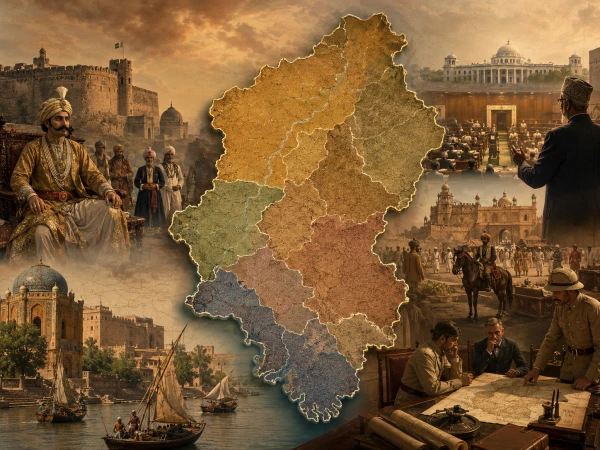
KARACHI: As debate intensifies across Pakistan over proposals for the creation of new provinces or administrative units, the question of whether Sindh has historically been divided has also come under discussion.
The issue has generated particularly strong debate in Sindh, where nationalist organisations have rejected proposals for any form of division, while the Pakistan Peoples Party (PPP) government in Sindh has maintained its opposition to the creation of new provinces or administrative units. Meanwhile, Muttahida Qaumi Movement-Pakistan (MQM-P) has voiced support for the idea of creating new provinces or administrative units.


Historically, Sindh has experienced several forms of administrative and political division, although these should not necessarily be equated with the modern concept of geographical partition, as occurred with Punjab and Bengal during the partition of British India.
During British rule, the British conquered Sindh in 1843 and attached it to the Bombay Presidency. After a prolonged political struggle, Sindh was separated from the Bombay Presidency in 1936 and given the status of a separate province. This was an administrative separation rather than an internal geographical division of Sindh.
Sindh Under the Talpurs
The Talpur dynasty ruled Sindh from 1783 to 1843. During this period, Sindh was politically and administratively organised into three largely autonomous states or sarkars, each controlled by different branches of the Talpur family.
The Hyderabad State, known as the Shahdani Sarkar, was ruled by Mir Fateh Ali Khan Talpur and his three brothers. Their collective rule became known as Chauyari, or the rule of four brothers, and covered Lower Sindh.
The Khairpur State, known as the Sohrabani Sarkar, was ruled by Mir Sohrab Khan Talpur, a cousin of Mir Fateh Ali Khan. It covered large parts of Upper and northern Sindh. The state continued to exist even after the British conquest of Sindh as a semi-autonomous princely state until 1955.
The third was the Mirpur Khas State, known as the Manikani Sarkar, ruled by Mir Tharo Khan Talpur. It extended across eastern Sindh and the Thar region. One of its prominent rulers was Mir Sher Muhammad Khan Talpur, popularly known as the “Lion of Sindh” for his resistance against the British.
In 1843, British General Sir Charles Napier defeated the Talpurs at the Battle of Miani and subsequently brought the territory of Sindh under unified British control.
Sindh During the Mughal Era
Earlier, during the Mughal period, Sindh was also organised into different administrative units.
In 1592, Mughal forces under Khan-i-Khanan defeated the Tarkhan rulers and incorporated Sindh into the Mughal Empire. The Mughals administered Sindh through two major sarkars.
The first was Bakhar (Bhakkar) Sarkar, centred around the Bhakkar Fort in present-day Sukkur. Mughal governors were appointed directly from Delhi to administer the area.
The second was Thatta Sarkar, centred on Thatta in Lower Sindh. Due to its importance as a coastal trading centre, the area remained under close Mughal supervision. Siwistan (Sehwan) was another important administrative centre situated between the two major regions.
Changes During the Kalhora Period
As Mughal power weakened, Mian Yar Muhammad Kalhoro and Mian Noor Muhammad Kalhoro gradually established control over large parts of Sindh. However, following Nadir Shah’s invasion of India in 1739, the political and territorial situation changed significantly.
During the later Kalhora period, Sindh was effectively divided into different spheres of control. The Kalhora government was centred in areas including Khudabad, Muhammadabad and Hyderabad, while other territories, including parts of Upper Sindh, Larkana, the Dera Ghazi Khan frontier and Sibi, came under the influence or control of the Khanate of Kalat or the Durrani Empire at different stages.
Political instability and conflicts between the Kalhoras and Talpurs further fragmented control over the region. Shortly before the Battle of Halani in 1783, Kalhora ruler Mian Abdul Nabi reportedly ceded several territories to the Khan of Kalat and Afghan rulers in an attempt to preserve his weakening authority.
Administrative Division or Geographical Partition?
Historians and commentators distinguish these historical arrangements from the modern concept of dividing a province into separate geographical entities.
The divisions during the Talpur, Mughal and Kalhora periods were largely political, administrative or feudal arrangements, under which local rulers, governors and administrators were given authority over territories for taxation, security and governance.
Therefore, while Sindh has repeatedly experienced changes in political boundaries, administrative control and governing structures throughout its history, these arrangements cannot automatically be described as a modern-style geographical partition of Sindh into separate provinces.
The distinction remains important in the ongoing political debate over proposals for new provinces or administrative units in Pakistan.
Note: The views expressed in this article are those presented in the source material and do not necessarily represent the views or policy of Express News.