Financial Times Highlights Gen Asim Munir’s Diplomatic Push to Revive US-Iran Talks Amid Global Challenges
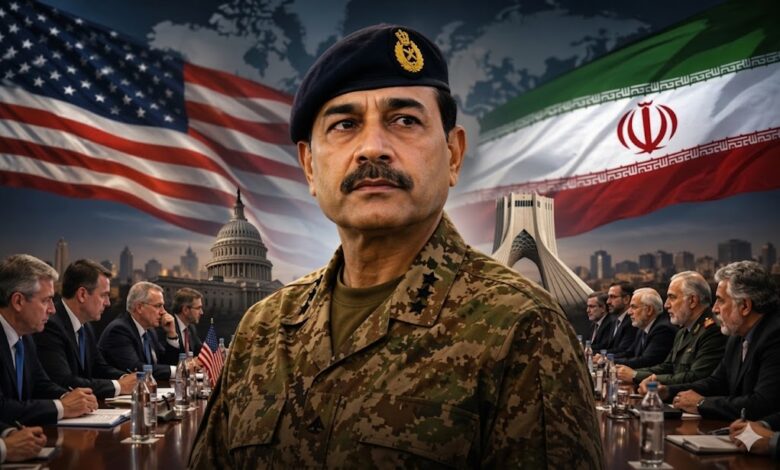
ISLAMABAD: Financial Times has acknowledged the active and unconventional diplomatic role of Pakistan’s Army Chief Asim Munir in efforts to ease tensions and revive stalled negotiations between the United States and Iran.
According to the report, Gen Asim Munir—who has twice led Pakistan’s intelligence apparatus—has adopted a proactive and multi-layered strategy to help restore dialogue between the two long-time adversaries. Earlier this month, he chaired a rare high-level meeting between the rivals and subsequently stayed in Tehran for several days, engaging with Iran’s political and military leadership, including the Revolutionary Guard.
Sources indicate that during this period, he also remained in close contact with the White House, reflecting Pakistan’s evolving ties with Washington. Analysts suggest that recent cooperation in areas such as minerals, cryptocurrency, and broader economic engagement has contributed to improved bilateral relations. Pakistan’s reported nomination of Donald Trump for the Nobel Peace Prize has also been seen as a gesture strengthening diplomatic goodwill.
While Pakistan has not traditionally played a central role in US-Iran mediation, it has emerged this time as an unexpected but significant intermediary. However, efforts to restart talks have recently stalled, presenting a major challenge for Islamabad’s diplomatic initiative.
Historically, countries such as Qatar and Oman, along with European powers, have attempted to mediate between Washington and Tehran with limited success. Unlike the prolonged and complex negotiations in Geneva and Vienna that led to the 2015 nuclear deal, Pakistan’s approach under Gen Munir has been more direct and multifaceted.
The military man trying to save US-Iran peace talks https://t.co/cdqNi8Fg8r

— Financial Times (@FT) April 22, 2026
Experts note that his intelligence background gives him a nuanced understanding of Iran’s power structure, enabling outreach to multiple centers of influence. At the same time, his reported personal rapport with Donald Trump—who recently described him as “impressive”—has added another dimension to the effort.
Despite these moves, progress halted after Iran declined to participate in a planned round of talks in Islamabad. The development underscores deep mistrust between the two sides. The US has reportedly refused to lift certain maritime restrictions, while Iran remains unwilling to fully reopen the strategically vital Strait of Hormuz.
Although a temporary extension in ceasefire-like conditions was reportedly achieved following requests from Pakistani leadership, key issues such as Iran’s nuclear program and uranium enrichment remain unresolved.
Officials in Pakistan say efforts to bridge differences are ongoing, but analysts caution that the initiative faces significant hurdles, including unpredictable US policy positions and Iran’s firm stance against negotiations under pressure.
Preparations had been underway in Islamabad for a potential agreement—often referred to as the “Islamabad Peace Accord”—with heightened security measures in place. However, the talks have since stalled, highlighting the complexity of achieving a breakthrough in one of the world’s most enduring geopolitical disputes.