Positive Shift in Balochistan: From Demands to Policy Recommendations for Women’s Rights
*By: Matiullah Matee*
As in the rest of the world, Pakistan—particularly Balochistan—is observing the global **16 Days of Activism Against Gender-Based Violence** with renewed commitment. The annual campaign, held from **November 25 to December 10**, is more than a symbolic tradition; it serves as a global call for awareness, responsibility and equality. This year’s theme, **“Ending Digital Violence,”** highlights the growing threats women and girls face in the online space amid rapid technological advancement.


### **A Constructive Shift: From Demands to Policy Recommendations**
In a positive and notable change, Balochistan’s civil society has shifted from making demands to putting forward **practical, policy-oriented recommendations**. This reflects a mature and solution-driven approach toward addressing gender-based violence and discrimination.
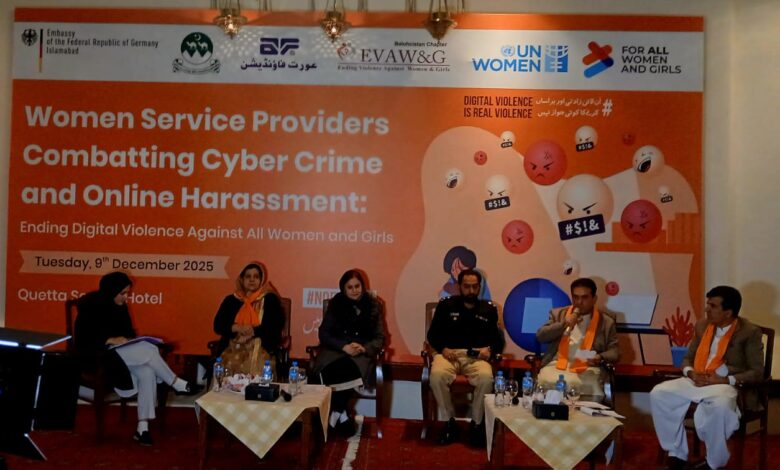
In this context, **Aurat Foundation**, **EVAW/G Alliance**, and **UN Women** organized an important event in Quetta aimed at promoting gender equality, addressing gender-based violence, and strengthening gender-sensitive justice systems.
### **Digital Age, New Forms of Violence**
Experts including **UN Women Balochistan Head Ayesha Wadood**, **Additional IG Gender Israr Ahmed Umrani**, **Ismatullah Khan**, **Sabira Islam**, **Fauzia Shaheen**, **Yasmeen Mughal**, and **Ashfaq Mengal** discussed the alarming rise in online harassment, blackmailing, fake profiles, misuse of personal photos, online tracking, and other digital abuses targeting women.
They stressed that without strong public awareness, improved digital privacy, secure passwords, prompt reporting mechanisms, and robust legal frameworks, digital violence cannot be effectively countered. Such incidents not only harm mental health but also affect women’s education, employment and personal dignity.
### **Civil Society’s Key Policy Recommendations**
**Regional Director of EVAW/G Alliance and Aurat Foundation, Alauddin Khilji**, presented comprehensive recommendations to the Balochistan government:
* Finalise *Rules of Business* for the already approved child marriage restraint bill.
* Introduce legislation for rehabilitation and support of acid attack survivors.
* Appoint the **provincial ombudsperson** for anti-harassment cases immediately.
* Ensure gender-sensitivity training and committees in all government departments.
* Guarantee equal representation of women across all government institutions.
* Improve accessibility for persons with disabilities in public offices.
* Ensure women receive party tickets for general seats in local government elections.
* Consider nominating a **female mayor or deputy mayor** for Quetta.
* Establish fast-track mechanisms for women-related cases in courts.
* Set up **Dar-ul-Amans** at divisional levels across Balochistan.
* Introduce gender-sensitive amendments to cybercrime laws for women’s online protection.
These recommendations are not mere paperwork—they outline practical steps toward building a safer and more empowered society for women in Balochistan.
### **Women’s Rights and Tribal Realities**
Despite rich traditions, tribal norms in Balochistan often restrict women’s rights. Issues such as inheritance denial, early marriages and treating women as property still persist. Strengthening women politically, educationally, economically, and administratively is key to genuine empowerment.
### **Government’s Position**
Addressing the event, **Parliamentary Secretary for Minority Affairs and Interfaith Harmony Sanjay Kumar Panjwani** said that Balochistan takes pride in its respectful traditions for women. He affirmed the government’s commitment to protecting women and children’s rights and working with civil society to advance gender justice.
### **A New Beginning for Women’s Rights in Balochistan**
Participants noted that the **16 Days campaign** is not just an event, but part of a continuous struggle for women’s rights. This year’s shift—from demands to well-structured recommendations—marks a thoughtful and progressive approach. It strengthens hope for policy reforms and highlights collective responsibility shared by civil society, government institutions, media and youth.
If this momentum continues, Balochistan could soon emerge as a province where women’s rights are not confined to slogans but are secured and upheld in everyday life.