Supreme Court Hears Intra-Court Appeals Against Military Court Trials for Civilians
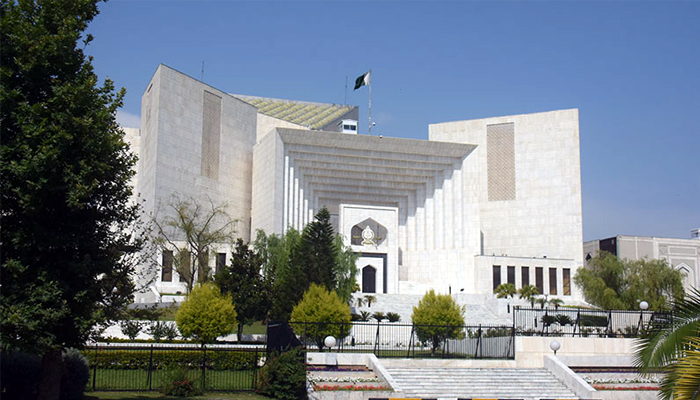
Quetta:The Supreme Court of Pakistan is hearing intra-court appeals challenging military court trials for civilians. The seven-member constitutional bench, led by Justice Ameenuddin Khan, commenced the hearing today.
At the beginning of the session, the Supreme Court Bar Association submitted written submissions, arguing that civilians should not be tried in military courts. They maintained that the provisions of the Army Act, which have been upheld in various judicial rulings, cannot be declared unconstitutional.


During the proceedings, Lahore High Court Bar Association’s lawyer, Hamid Khan, referenced the era of former Chief Justice Umar Atta Bandial, mentioning the arrest of PTI founder Imran Khan by the Islamabad High Court. Justice Jamal Mandokhel interrupted him, stating, “Please focus on whether civilians can be tried in military courts or not.”
Justice Mandokhel emphasized that the central issue was the legitimacy of military trials for civilians. In response, Hamid Khan explained that the Army Act was introduced in May 1952, while Pakistan’s first constitution came into effect in 1956, which incorporated fundamental rights. He added that the Army Act was amended for the first time in 1967.
Hamid Khan further clarified that the first case under the Army Act was the 1951 Rawalpindi Conspiracy Case, where the aim was to establish a communist system in the country. He pointed out that the military trial for the accused in the Rawalpindi Conspiracy Case was not held in military courts but in a special tribunal.
Justice Jamal Mandokhel inquired whether the Army Act existed in 1951, to which Hamid Khan replied that the military act in effect at that time was from 1911. Justice Muhammad Ali Mazhar then asked whether special tribunals were specifically created for the Rawalpindi Conspiracy Trial, and Hamid Khan confirmed this, asserting that the case involved both civilians and military personnel.
Hamid Khan also noted that military courts were first established in 1953 following the Ahmadis’ riots in Lahore, during which martial law was imposed in the city. Military courts were formed to trial the individuals involved in the Ahmadia unrest.
Justice Hassan Azhar Rizvi, interjecting, reminded that those convicted in these cases later received pardons. Justice Jamal Mandokhel questioned how these historical events related to the issue of military trials today, emphasizing that martial law is not permissible under the constitution.
Hamid Khan responded by stating that martial law is often circumvented through legal means, but the Supreme Court had closed that avenue. Justice Muhammad Ali Mazhar reiterated that martial law is not mentioned in the constitution and is an extra-constitutional measure.
The court continues to deliberate on whether military trials for civilians are constitutional, with significant arguments being presented on the legality of the Army Act and its application to civilian matters.