A History of Governor’s Rule and Emergency in Pakistan: How Many Times Have Provincial Governments Been Sent Home?
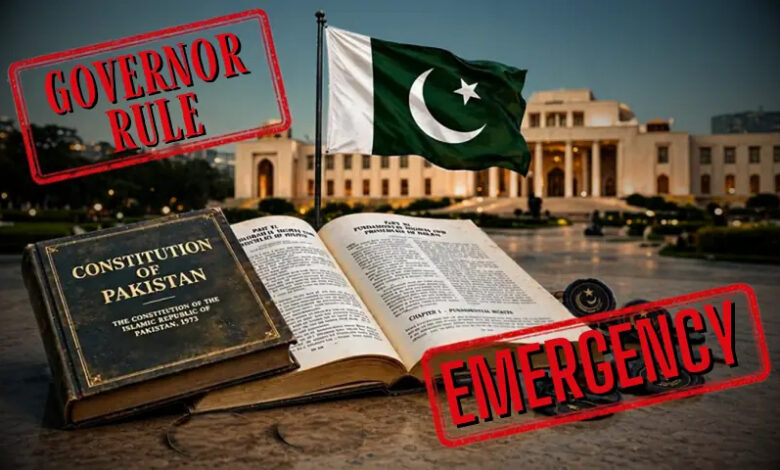
Peshawar (Qudrat Daily): In Pakistan’s political history, whenever tensions between the federation and a province have peaked or a crisis has emerged in a province, terms like “Governor’s Rule” or “Emergency” have come to the forefront. This is the constitutional weapon through which a government sitting in the federation can send home even a government holding a majority mandate in a province. Since the creation of Pakistan, every province of the country has faced this constitutional weapon at least once. On October 11, Governor’s Rule has once again been imposed in Khyber Pakhtunkhwa for the fourth time.
Following President Asif Ali Zardari’s signature on Sunday on the summary to impose “Emergency” and “Governor’s Rule” in Khyber Pakhtunkhwa on the recommendation of the federal cabinet, all powers of the elected provincial government have been transferred to the bureaucracy and the Governor. The President granted this approval on the recommendation of Prime Minister Shehbaz Sharif.


Previously, the federal cabinet had formally approved the imposition of “Governor’s Rule” and “Emergency” in Khyber Pakhtunkhwa under Articles 232 and 234 of the Constitution of Pakistan. After the President’s signature, the reins of all administrative affairs of Khyber Pakhtunkhwa will now formally be in the hands of Governor of Khyber Pakhtunkhwa Faisal Karim Kundi.
When, Why, and How Have Past Federal Governments Used Constitutional Weapons Like Governor’s Rule or Emergency Against Provincial Governments?
Before examining this, it is essential to understand the fundamental difference between “Emergency” and “Governor’s Rule,” and whether the Constitution truly grants the federation the authority to remove an elected Chief Minister and his cabinet and hand over all powers to a bureaucrat or Governor.
Part 10 of the Constitution of Pakistan explains the imposition of “Governor’s Rule” or “Emergency” in any province. Whenever the federation takes over a province’s system, it relies on three fundamental constitutional provisions of Part 10: Article 232, Article 234, or Article 235.
Emergency
Article 232 grants the President the authority to impose an emergency in the face of threats to national security such as war, external aggression, or severe internal disturbance (which the provincial government cannot control). In this situation, the provincial assembly remains intact; however, extensive legislative authority over provincial matters also comes to the federation.
Governor’s Rule
According to Article 234, if the President is satisfied, whether from a report by the Governor or through any other source, that the provincial government has failed to run the province’s system in accordance with the Constitution, he may suspend or dissolve the provincial government and assembly and entrust all administrative powers to the federation’s representative, i.e., the Governor.
Pakistan’s political history is a long saga of tug-of-war and tension between the center and the provinces. From immediately after the creation of Pakistan to the present day, every province of the country has tasted this bitter sip at least once.
The history of Governor’s Rule in Punjab holds particular significance, where from 1949 to 2009, the powers of the provincial government went into the Governor’s hands three times. Governor’s Rule was also imposed in Sindh, Khyber Pakhtunkhwa, and Balochistan during various periods.
History of Governor’s Rule and Emergency in Pakistan
First Governor’s Rule – 1949
In Pakistan’s history, the powers of Punjab’s provincial government went into the Governor’s hands three times. The country’s first formal Governor’s Rule was also imposed in Punjab in January 1949, targeting the government of Punjab’s first Chief Minister, Iftikhar Hussain Mamdot, who was dismissed on charges of corruption, nepotism, and mismanagement. However, according to historical references, the real reason for Chief Minister Iftikhar Mamdot’s dismissal was his severe differences with the center and with his own Finance Minister, Mumtaz Daultana.
Although the recent imposition of emergency and Governor’s Rule in Khyber Pakhtunkhwa has relied on the 1973 Constitution, in 1949, since the country’s formal Constitution had not yet come into existence, Prime Minister Liaquat Ali Khan used the interim Constitution—the Government of India Act 1935 (Section 92-A)—to remove Iftikhar Hussain Mamdot’s government and entrusted all powers to Governor Francis Mudie.
The first Governor’s Rule in Punjab ended in 1951 after the holding of provincial assembly elections, as a result of which Mian Mumtaz Daultana was elected the new Chief Minister. However, in 1953, using the deteriorating law and order situation in Punjab as a pretext, the government of Chief Minister Mian Mumtaz Daultana was also dismissed.
End of Shehbaz Government – 1999
Shehbaz Sharif, who on October 11 approved Governor’s Rule and emergency in Khyber Pakhtunkhwa as Prime Minister of Pakistan, has himself twice been a target of this constitutional weapon in the past.
In October 1999, Shehbaz Sharif was Chief Minister of Punjab. On October 12, when the then Army Chief General (Retd.) Pervez Musharraf overthrew the elected government of Prime Minister Nawaz Sharif and imposed emergency, the government of Chief Minister Shehbaz Sharif in Punjab, like other provinces, was also dissolved, and the province’s administration was directly handed over to the Governor of Punjab. The second Governor’s Rule in Punjab continued until November 23, 2002.
End of Shehbaz Sharif’s Second Government – 2009
Governor’s Rule was imposed in Punjab for the third time on February 25, 2009, based on the Supreme Court’s decision disqualifying Nawaz Sharif and Shehbaz Sharif from contesting elections.
As soon as this decision came out, President Asif Ali Zardari immediately imposed Governor’s Rule in Punjab for two months under Article 234, and Salman Taseer took over the province’s administration as Governor. However, an important difference this time was that the Punjab Assembly was not suspended; rather, only Chief Minister Shehbaz Sharif and members of his cabinet were barred from working in their positions.
First Governor’s Rule in Sindh – 1951
Like Punjab, Governor’s Rule has been imposed three times in Sindh. Just two years after the country’s first Governor’s Rule, in 1951, Sindh’s first Chief Minister, Ayub Khuhro, and his cabinet also had to go home as a result of Governor’s Rule.
At that time, Quaid-e-Azam Muhammad Ali Jinnah was the Governor-General of the country and Liaquat Ali Khan was the Prime Minister. The federal government dismissed Ayub Khuhro’s government on charges of corruption and misuse of authority and imposed Governor’s Rule in the province, and Mian Aminuddin managed the province’s affairs as Governor until 1953.
Earlier, on Quaid-e-Azam’s orders in April 1948, Ayub Khuhro’s government had also been dismissed on the same charges; however, at that time, instead of Governor’s Rule, a law called “PRODA” (Public and Representative Offices Disqualification Act) was used.
Second Governor’s Rule in Sindh
The second period of Governor’s Rule in Sindh spanned 68 days, beginning on June 24, 1988, and ending on August 31, 1988.
This decision was made when a government comprising politicians belonging to the Islami Jamhoori Ittehad (IJI) was in place in the province, with Chief Minister Akhtar Ali Ghulam Qazi.
When the then President General Zia-ul-Haq dismissed the federal government of Prime Minister Muhammad Khan Junejo and the National Assembly, all provincial governments were also dissolved, and Chief Minister Akhtar Ali Ghulam Qazi’s government also fell victim to this decision.
General Zia-ul-Haq appointed General (Retd.) Rahimuddin Khan as Governor and delegated unlimited powers under Governor’s Rule. After the end of Governor’s Rule, Akhtar Ali Ghulam Qazi was reappointed as caretaker Chief Minister of Sindh for the 1988 general elections.
Murder of Hakim Saeed – 1998
This was the most significant Governor’s Rule in Sindh’s history. In October 1998, the renowned scholarly figure and former Governor of Sindh, Hakim Muhammad Saeed, was martyred in Karachi. At that time, a coalition government of Muslim League-N and MQM was in place in Sindh, and Liaquat Jatoi was the Chief Minister.
After this high-profile murder, in view of the deteriorating law and order situation in Karachi and across Sindh, Prime Minister Mian Nawaz Sharif suspended his own coalition government and imposed emergency in the province. During this period, Moinuddin Haider continued to run the province’s system, and Governor’s Rule remained in force in the province until General Pervez Musharraf took power in 1999.
Governor’s Rule in Sarhad Province – 1975
Under the 1973 Constitution, the first formal Governor’s Rule in any province was imposed in Sarhad Province (present-day Khyber Pakhtunkhwa) on February 16, 1975, and remained in force for 76 days.
In February 1975, a bomb blast at Peshawar University killed senior Pakistan Peoples Party leader Hayat Muhammad Khan Sherpao. This incident brought tensions between the federation and the provincial government to a peak.
Prime Minister Zulfikar Ali Bhutto, accusing the provincial government of failing to maintain law and order, ended the coalition government of the National Awami Party (NAP) and Jamiat Ulema-e-Islam in the province. After this action, Chief Minister Sardar Inayatullah Khan Gandapur had to go home, and the provincial government’s administrative powers were transferred to the Governor.
Second Governor’s Rule in Sarhad – 1994
The second dismissal of an elected government in Sarhad Province also occurred during the tenure of the Pakistan Peoples Party’s federal government, when Benazir Bhutto was Prime Minister of Pakistan and Pir Sabir Shah was Chief Minister of the coalition government of Muslim League (N) and Awami National Party (ANP) in the province.
President of Pakistan Farooq Leghari, on the recommendation of the federal government, issued an order on February 25, 1994, under Article 234 of the Constitution of Pakistan to impose Governor’s Rule for two months, which continued until April 24, 1994.
Third Governor’s Rule in Sarhad – 1999
In October 1999, President General Pervez Musharraf imposed a state of emergency across the country, as a result of which the entire federal and provincial democratic structure was wrapped up. Therefore, in Sarhad Province too, Muslim League-N Chief Minister Mahtab Abbasi had to go home, and Lieutenant General (Retd.) Muhammad Shafiq took over the province’s administration as Governor.
The third Governor’s Rule in Sarhad continued for more than three years, remaining in place until Akram Khan Durrani of the Muttahida Majlis-e-Amal took oath as Chief Minister in November 2002. This period is described as the longest Governor’s Rule in the province’s history.
Fourth Governor’s Rule – 2026
On Sunday, both emergency and Governor’s Rule have once again been imposed in Khyber Pakhtunkhwa. In the President’s House declaration, the reason for this action was cited as the increasing incidents of terrorism in the province, the deteriorating law and order situation, and threats to the lives and property of citizens.
After the President’s signature on the summary sent by Prime Minister Shehbaz Sharif, all executive powers of the province have now been transferred from PTI government’s Chief Minister Sohail Afridi to Governor Faisal Karim Kundi, while a notification for the deployment of the army in the province has also been issued.
According to the presidential order, emergency has been imposed under Article 232 of the Constitution in the former FATA and adjacent tribal districts, while the affairs of 12 specific districts suffering from severe unrest—Kurram, Upper Waziristan, Lower Waziristan, North Waziristan, Bajaur, Mohmand, Khyber, Orakzai, Bannu, Lakki Marwat, Tank, and Dera Ismail Khan—will be viewed under a separate and special strategy.
Governor’s Rule in Balochistan – 1973 to 2013
In the political history of Balochistan Province, Governor’s Rule has been imposed four times so far. In the province’s political history, the first time the federation used the constitutional authority of Governor’s Rule against an elected government was on February 15, 1973, and the incident used as the basis for it was extremely dangerous.
In Balochistan, a coalition government of Jamiat Ulema-e-Islam led by Mufti Mahmood and the National Awami Party (NAP) was in place. Prime Minister Zulfikar Ali Bhutto, after the discovery of an arms shipment from the Iraqi embassy in Islamabad, dismissed Sardar Ataullah Mengal’s government on charges of rebellion and taking up arms against the center by his party (National Awami Party).
Along with the dismissal of the Chief Minister, Governor Mir Ghaus Bakhsh Bizenjo was also removed from office, and Nawab Akbar Bugti was appointed the new Governor of Balochistan. After this, a long military operation began in the province.
In protest against the dismissal of Balochistan Chief Minister Ataullah Mengal, Sarhad Province (KP) Chief Minister Mufti Mahmood also tendered his resignation.
The second Governor’s Rule in Balochistan was also imposed in December 1975 during the tenure of Prime Minister Zulfikar Ali Bhutto, under which Chief Minister Jam Mir Ghulam Qadir Khan was replaced and the province’s powers were delegated to Governor Mir Ahmad Yar Khan (Khan of Kalat).
The primary reasons for this Governor’s Rule were cited as severe unrest in various parts of the province, tribal clashes, and complaints of failure and alleged corruption by the provincial administration. On the recommendation of Prime Minister Zulfikar Ali Bhutto, President Fazal Ilahi Chaudhry imposed Governor’s Rule to restore administrative order in the province, which remained in place for approximately one year (December 1975 to December 1976).
An interesting fact is that among the five advisors appointed by the federation to assist Governor Mir Ahmad Yar Khan in running administrative affairs during Governor’s Rule, one was former Chief Minister Jam Mir Ghulam Qadir Khan, whose government had been dismissed to impose Governor’s Rule.
The third dismissal of an elected government in Balochistan Province was due to the “national emergency” imposed across the country after General Pervez Musharraf took power on October 12, 1999.
At that time, Mir Jan Muhammad Jamali was the elected Chief Minister of Balochistan, and with the end of the Nawaz Sharif government at the center, his government was also dissolved. This Governor’s Rule also continued until the 2002 general elections, and during this three-year-long period, former Chief Justice of the Balochistan High Court and then-Governor Justice (Retd.) Amirul Mulk Mengal remained the caretaker of the provincial government.
The fourth Governor’s Rule in Balochistan remained in force from January 14, 2013, to March 13, 2013.
In January 2013, devastating bomb blasts occurred one after another on Alamdar Road in Quetta, in which more than 100 people from the Hazara community were killed. The Hazara community staged a sit-in on Alamdar Road for three days in severe cold and rain with the bodies of the victims, and their demands included the dismissal of the provincial government.
After nationwide protests, Prime Minister Raja Pervez Ashraf himself reached Quetta and on January 13, 2013, announced the dismissal of the Aslam Raisani government under Article 234 of the Constitution and the imposition of Governor’s Rule in the province for two months.
Under the presidential order, Governor Nawab Zulfikar Magsi was appointed as the province’s Chief Executive. Since the two-month constitutional period of Governor’s Rule imposed under Article 234 was ending on March 13, 2013, the federal government, instead of extending it, restored Nawab Aslam Raisani’s government for a few days.
After the end of Governor’s Rule, Nawab Aslam Raisani and opposition leader Nawabzada Tariq Magsi agreed on the name of Nawab Ghaus Bakhsh Barozai for caretaker Chief Minister of Balochistan.
Thus, while Sindh and Punjab have each seen Governor’s Rule 3 times, Khyber Pakhtunkhwa (formerly Sarhad) and Balochistan have each seen elected governments suspended or dismissed through Governor’s Rule or emergency 4 times.


