Supreme Court Debates Judicial Transfers, Seniority, and Constitutional Authority in Landmark Case
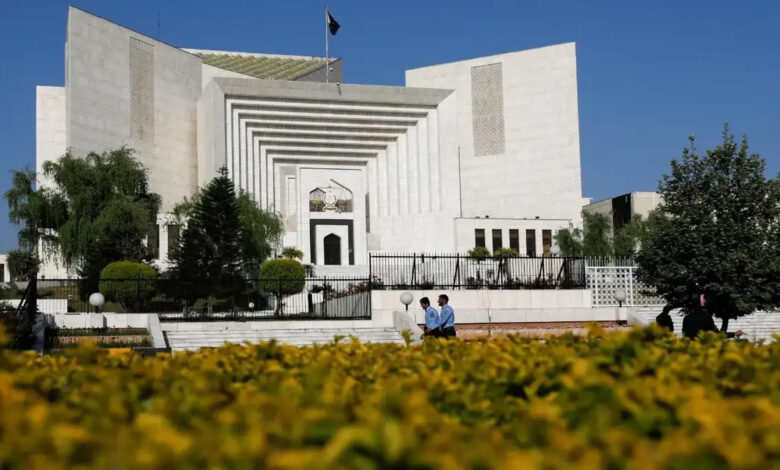
In a high-profile hearing at the Supreme Court of Pakistan, a five-member constitutional bench led by Justice Muhammad Ali Mazhar held an in-depth discussion on the legality and constitutionality of **high court judges’ transfers**, focusing on issues of **seniority**, **judicial independence**, and **consensual postings**.
Advocate Faisal Siddiqi presented his arguments, challenging the legal basis for transferring judges between high courts. He argued that the **Islamabad High Court was established under Article 175 of the Constitution**, which allows for the appointment of judges from the provinces but does **not explicitly permit transfers**.


During the hearing, Justice Shakeel Ahmed remarked that if a uniform **seniority list** were maintained, as in India, disputes would be minimal. Justice Mazhar responded by noting that in India, **judicial transfers can be made without the consent** of the judge concerned.
Faisal Siddiqi contended that any such transfer would be temporary unless clearly allowed by law, adding that even if a judge takes a fresh oath after transfer, the original oath must be considered **continuously valid**. He warned against executive interference, calling the overnight changes to seniority lists a **”usurpation of judicial authority.”**
Justice Mazhar emphasized that judicial transfers in Pakistan involve a **four-stage process**, requiring the approval of:
1. The Chief Justice of the transferring high court,
2. The Chief Justice of the receiving high court,
3. The judge being transferred, and
4. The Chief Justice of Pakistan.
He clarified that **if any one of these four refuses**, the transfer cannot proceed, underscoring that the judiciary—not the executive—holds authority over such decisions.
The court also deliberated whether **Article 175A**, which governs judicial appointments through the Judicial Commission, has overridden **Article 200**, which originally dealt with judicial transfers. Siddiqi responded that allowing routine transfers undermines the independence of the judiciary and bypasses the role of the Judicial Commission.
He maintained that judges must be made aware of the outcomes of changes in seniority or transfers, and that **permanent transfers** without full transparency and legal basis would violate both **constitutional spirit and judicial process**.
The hearing highlighted deep constitutional and institutional questions about the **balance between judicial discretion and administrative processes**, with the court reserving its judgment on the matter.