Fearing World War III, U.S. Defense Giant Unveils Laser-Equipped Spy Drones Capable of Melting Missiles
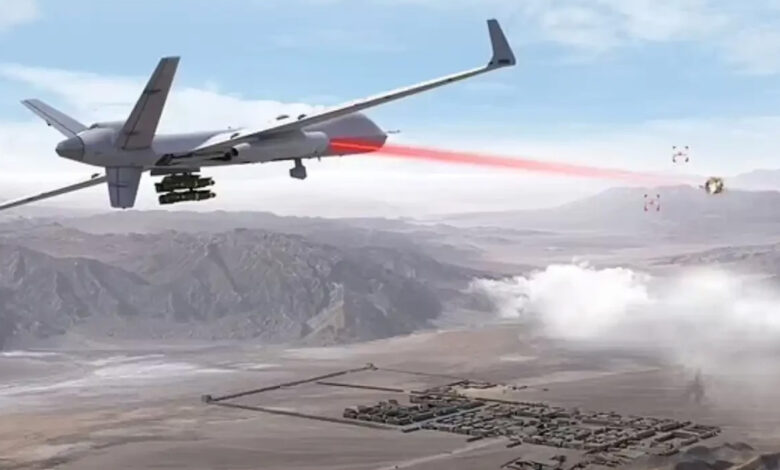
Washington D.C.: Amid growing concerns of a potential World War III, American defense contractor General Atomics has introduced a groundbreaking military technology — a high-energy laser system mounted on stealth spy drones capable of melting enemy missiles mid-air.**
Unveiled at the *Sea-Air-Space 2025* exhibition held this month in National Harbor, Maryland, the technology features a 25-kilowatt laser integrated into the MQ-9B SkyGuardian drone — an advanced autonomous aircraft designed for intelligence, surveillance, and reconnaissance missions.


This laser system is currently capable of neutralizing or destroying small aerial threats and is being touted as a low-cost solution to counter disposable drone swarms. General Atomics claims that the system’s power can be scaled up to 300 kilowatts, enabling it to melt structural components of larger aircraft and ballistic missiles.
The laser operates in both continuous and pulsed modes and is engineered to function effectively in a variety of weather conditions — a key advantage over traditional weapons. A demo video shown at the expo depicted the MQ-9B drone successfully destroying Iranian-made Shahed-style kamikaze drones as they approached a naval vessel.
What sets this technology apart is its invulnerability to conventional countermeasures: the laser beam itself cannot be intercepted, and as long as power is supplied, it can inflict uninterrupted damage. However, the primary limitation remains the drone’s onboard energy capacity, which could affect laser performance during extended battlefield operations.
The MQ-9B drone boasts an endurance of up to 40 hours at an altitude of 40,000 feet, making it a formidable platform for high-energy laser deployment.
This breakthrough marks a significant milestone in making high-energy lasers (HELs) a practical component of modern air defense systems. It also builds on previous research, including the U.S. Air Force’s now-defunct Self-Protect High Energy Laser Demonstrator (SHiELD) program, which — despite being shelved in 2024 without a prototype flight — laid crucial groundwork for airborne laser development.
The timing of this advancement is particularly relevant as the use of fast, low-cost kamikaze drones surges in conflict zones like Ukraine and the Middle East. Between August 1, 2024, and March 1, 2025, Ukraine reported 15,011 attacks using Iranian-made Shahed drones by Russian forces.
In such a landscape, where conventional missile defense proves too expensive and slow, laser-based systems offer a precise, cost-effective, and scalable solution to emerging threats.