Black Stone of the Kaaba: Sacred jewel of Paradise and symbol of forgiveness
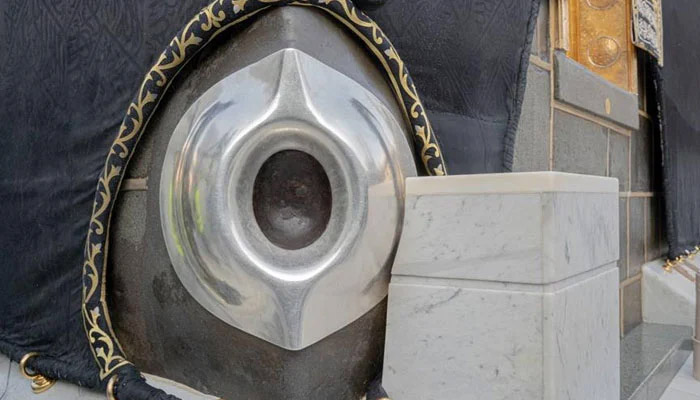
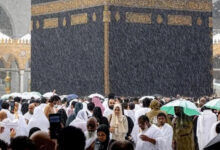
Makkah: The Hajar-e-Aswad (Black Stone), installed at the southeastern corner of the Holy Kaaba, is one of the most revered sacred relics in Islam. The word “Hajar-e-Aswad” literally means “Black Stone,” and it holds immense spiritual significance for Muslims performing Tawaf during Hajj and Umrah.
Islamic traditions describe it as a stone that descended from Paradise and was brought to Earth by Prophet Adam (peace be upon him). It is set in a silver frame and is currently composed of several fragments held together.

According to historical and religious narrations, the stone was originally whiter than milk but turned black over time due to the sins of mankind and various incidents throughout history. It is placed about 1.10 meters above ground level and is approximately 25 cm in length and 17 cm in width.
Religious sources state that touching or kissing the Black Stone (Istilam) during Tawaf is a Sunnah practice. The act symbolizes devotion and spiritual connection, and it is believed that the stone will testify in favor of those who sincerely performed this act on the Day of Judgment.
Islamic scholars and narrations describe the Black Stone as a “jewel from Paradise,” and it is associated with multiple historical events, including its placement by Prophet Ibrahim (peace be upon him) during the reconstruction of the Kaaba and later by Prophet Muhammad (peace be upon him) during the rebuilding by the Quraysh.
The most notable historical incident occurred when disputes arose among Quraysh tribes over who would have the honor of placing the stone back in its position. The Prophet Muhammad (PBUH) resolved the dispute by placing the stone on a cloth and asking leaders of all tribes to lift it together, ensuring unity and preventing conflict.
Throughout history, the Black Stone has witnessed numerous events, including attacks, attempts of theft, and reconstruction phases of the Kaaba. One of the most tragic incidents recorded in Islamic history was the attack by the Qarmatians in 317 AH, during which the stone was taken away for over two decades before being returned to Makkah.
Despite centuries of turmoil, the Black Stone remains preserved in the Kaaba, continuing to hold deep religious, historical, and spiritual significance for Muslims around the world.