Lahore Tops Global Air Pollution Ranking Again with Hazardous AQI Levels
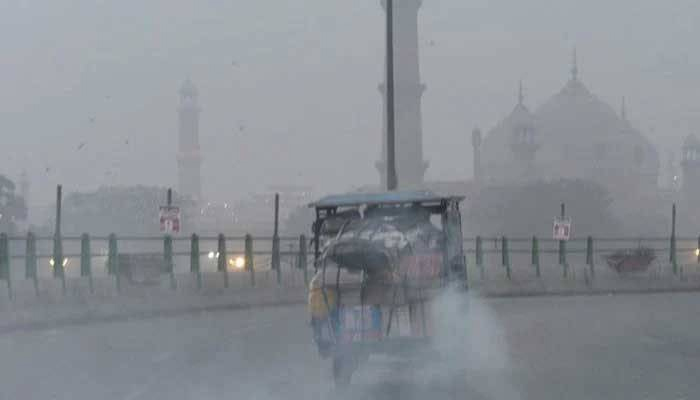
LAHORE: According to the global air quality monitoring organization **IQAir**, Lahore has once again ranked as the most polluted city in the world, recording an **average Air Quality Index (AQI) of 378**. Delhi and Tashkent followed with AQI levels of 288 and 175 respectively.
As per Punjab’s official data, **Sheikhupura** has been identified as the most polluted city in the province, with a critically high **AQI of 500**. Lahore stands second at 372, followed by **Gujranwala (294)**, **Faisalabad (255)**, and **Multan (194)**. Other cities among the top ten include **Sargodha (186)**, **Dera Ghazi Khan (179)**, **Bahawalpur (159)**, **Sialkot (156)**, and **Rawalpindi (124)**.


Within Lahore, air quality has reached alarming levels in several areas — **Shahdara (500)**, **Multan Road (395)**, **Punjab University area (393)**, **Safari Park (367)**, **Kahna (346)**, **Burki Road (340)**, **GT Road (337)**, and **DHA Phase 6 (320)** — all far exceeding the **World Health Organization’s (WHO)** safe limits.
Experts attribute the worsening air quality to **polluted winds from Indian Punjab** and a **15% increase in crop residue burning** compared to last year. The smog has spread across central Punjab, including Lahore, Kasur, Sheikhupura, and Gujranwala.
The **Meteorological Department** reported that due to **low wind speeds (3–5 mph)** and falling temperatures, the dispersion of pollutants has decreased. High humidity levels (95–100%) during nighttime and early morning hours cause pollutants to settle close to the ground, severely reducing visibility.
During the day, sunlight slightly improves air quality, but smog thickens again after sunset. The **Environment Department** noted that persistent **low-pressure zones, dry weather, and cross-border pollution** have worsened the situation.
In response, the **Punjab government** has intensified its **anti-smog campaign**. Joint teams from the Agriculture and Environment Departments are taking action against farmers burning crop residues in districts such as Lahore, Nankana Sahib, and Kasur.
Official data shows that the use of **5,000 “Super Seeders”** has saved **400,000 acres** of farmland from being burned. The government has also distributed **600,000 eco-friendly farming machines**, including **super seeders, harvesters, Kubota harvesters, and balers**, allowing farmers to recycle crop residues into fodder or biofuel instead of burning them.
Public awareness campaigns are also underway in rural areas through **mosque announcements and local community meetings** to discourage stubble burning. In urban zones, authorities have deployed **“Smog Guns” (fog cannons)** to spray mist and temporarily reduce particulate matter in heavily polluted areas.
According to the Environment Department spokesperson, this year’s **smog monitoring system** is more advanced and coordinated than before. Officials urged citizens to **stay calm but cooperate**, avoid unnecessary travel during early morning and evening hours, and ensure **mask usage**, especially for vulnerable groups.
The **Meteorological Department** added that if wind speeds increase slightly over the next 48 hours, a **minor improvement in air quality** may be expected.