Balochistan High Court Takes Notice of Non-Supply of Drinking Water in Hazara Town, Karkhsa and Hazarganji; Concern Over Delay in Implementation of Court Orders
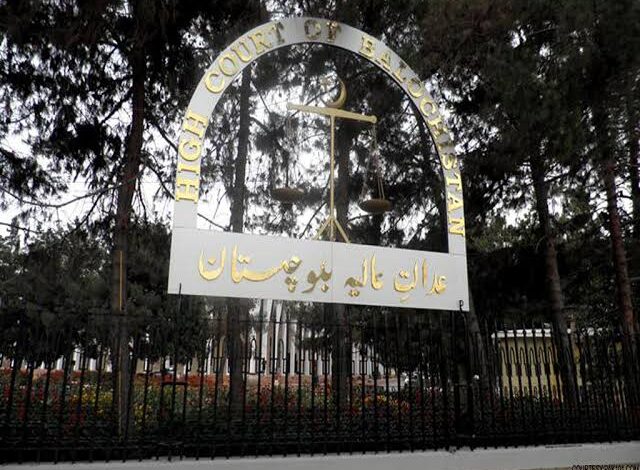
QUETTA (Daily Qudrat Quetta): The Balochistan High Court has taken notice of the non-supply of drinking water in Hazara Town and Hazarganji and directed the relevant authorities to appear in person and submit a comprehensive report. A two-member bench comprising Chief Justice Balochistan High Court Justice Muhammad Kamran Khan Mulakhail and Justice Muhammad Najamuddin Mengal, hearing a constitutional petition regarding the supply of drinking water in Hazara Town, Karkhsa and Hazarganji and the alleged monopoly of private tube well owners, expressed concern over the delay by the relevant authorities in implementing court orders.
During the hearing, Chief Justice Muhammad Kamran Khan Mulakhail remarked that the said constitutional petition was filed on 21 September 2023; however, despite numerous orders and repeated directions issued by the court at various times, no substantial progress has so far been visible from the Quetta Water and Sanitation Authority (WASA).


On the court’s query, WASA’s executive engineer took the position that tube wells have been activated in the Karkhsa area, while two water reservoirs of 300,000 and 200,000 gallon capacity also exist, through which drinking water is being supplied to areas where the pipeline network is available. He further said that the installation of 11 tube wells in the Hazarganji area has also been completed; however, due to certain official and administrative issues, work was disrupted after K-Electric (KESCo) officials were arrested by police. Now an NOC has been issued in WASA’s favour, and the remaining necessary work is expected to be completed in the next five to six months.
On the other hand, the petitioners’ counsel, rejecting WASA’s position on behalf of the area residents, especially the residents of Hazara Town, told the court that the area residents still do not have proper drinking water facilities, and private tube well owners are allegedly maintaining a monopoly over water supply. According to him, area residents, despite making monthly payments, are deprived of water supply at the official level, while the sale of water by private tube well owners continues.
The petitioners’ counsel further took the position that despite the court’s orders issued on 9 October 2025 and 1 December 2025, effective measures have not been taken to stop private tube well owners from using WASA’s pipelines and selling water, due to which the problems of area residents persist.
In view of these circumstances, the court directed the Commissioner Quetta Division, Deputy Commissioner Quetta, Managing Director WASA, Chief Engineer WASA, Secretary Public Health Engineering (PHE) and other relevant authorities to appear in person at the next hearing and present a comprehensive report.
The court specifically directed the Deputy Commissioner Quetta, as Chairman of the Balochistan Ground Water Rights, to present a report on the total number and details of tube wells established and functional in the area and their legal status, and to clarify whether the relevant tube well owners have NOCs issued by the authorised authorities or not.
Furthermore, the court directed WASA’s legal adviser to also place on the judicial record the legal advice issued regarding B-WASA (Balochistan WASA). Directions were also given to send copies of the order to the relevant authorities and the office of the Advocate General Balochistan for necessary information and compliance.
The court adjourned further hearing of the case until 2 November 2026 and directed the relevant authorities to ensure implementation of the directions.