Sindh Government Seeks $350 Million World Bank Funding for Flood Resilience
KARACHI: The Sindh government has proposed $350 million in financial assistance from the World Bank for the Sindh Flood Resilience Project for fiscal year 2027, aimed at protecting the province’s rural and urban areas from future floods and climate-related risks.
The proposal was presented during an important meeting between the Sindh government and a World Bank delegation on development projects in the province. The meeting was chaired by Sindh Minister for Irrigation, Planning and Development Jam Khan Shoro.


The World Bank delegation included Lead Urban Specialist Saleem Rohana, Task Team Leader and Disaster Risk Management Specialist Bilal Khalid, and Amparo Semper Heraldo.
Planning and Development Chairman Najam Shah, Irrigation Secretary Zarif Khero and P&D Board Member Water Muhammad Ehsan Laghari also attended the meeting.
Jam Khan Shoro said the Sindh government had proposed $350 million in World Bank financing for the Sindh Flood Resilience Project for fiscal year 2027.
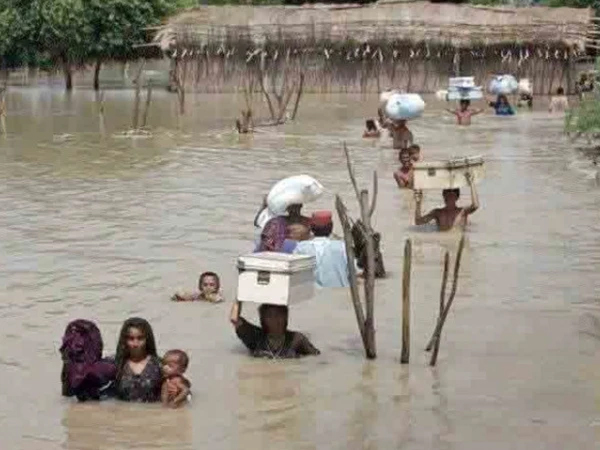
He said the devastating floods of 2022 affected 14.6 million people in Sindh and caused an estimated $9.1 billion in financial and infrastructure losses. Around 1.71 million houses were damaged or destroyed in the floods.
The provincial minister said seven districts on the right bank of the Indus River faced a risk of annual economic losses of around $1.11 billion, with approximately 2.23 million people potentially exposed to flooding.
The meeting was informed that $1.6 billion in financial assistance had so far been mobilized under World Bank-funded projects in Sindh. More than 848 kilometers of roads had been rehabilitated, while rehabilitation of 205 kilometers of flood protection embankments had also been completed.
Shoro said more than 900,000 houses had been constructed or rehabilitated in Sindh, while 26 modern Rescue 1122 stations had been established in 14 districts.
Officials briefed the meeting on progress toward approval of the Sindh Flood Resilience Project. Project concept clearance from the Central Development Working Party (CDWP) is expected by October 30, while approval of the project’s PC-I is anticipated by December 2026. Final approval from the World Bank Board is expected by March 2027.
The meeting also received a detailed briefing on the first component of the proposed project, the Basin-Level Flood Resilience component. Shoro said its primary objective was to protect areas along the right bank of the Indus River from future flooding.
He said flood protection measures for the right bank had been identified through a research study conducted by the Asian Institute of Technology.
The second component, Urban Resilience, was also discussed in detail. Shoro said the component would focus on protecting secondary cities in Sindh from floods, extreme heat and other climate-related hazards.
He said the proposed interventions would take into account flood risks, population vulnerability and gaps in urban services to identify and implement necessary measures.
According to the provincial minister, region-based investments were being considered to improve urban drainage, roads, streets and public spaces. Proposals for environmentally friendly green solutions in Sindh’s urban areas were also being reviewed.
Shoro said strengthening rural and urban infrastructure to address future floods and climate-related risks was a priority for the Sindh government. He added that sustainable urban planning, effective drainage systems and the use of modern technology would help make Sindh more resilient to natural hazards.