Entire country facing rebellion-like situation, decisions being made by “one mind,” says Maulana Fazlur Rehman
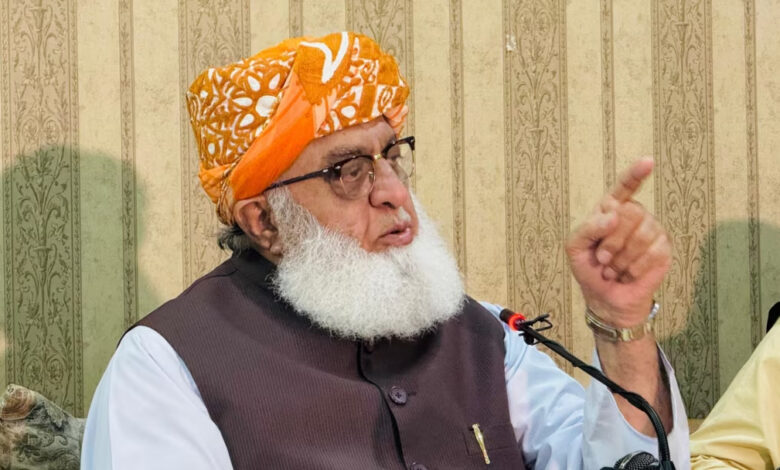
KARACHI (Kuwait News Desk) — Chief of Jamiat Ulema-e-Islam (F) Maulana Fazlur Rehman has said that Pakistan is facing a “rebellion-like situation” across the country and alleged that all major decisions are being made by “one mind.”
Addressing a press talk in Karachi, he strongly criticized powerful institutions, the electoral system, and government policies, saying the country is going through an extremely serious and complex crisis.

Maulana Fazlur Rehman said that conditions in Khyber Pakhtunkhwa and Balochistan resemble rebellion, where armed groups have taken up weapons against the state. He added that some groups are demanding separation while others want to impose their interpretation of Sharia through force.
He further said that in interior Sindh, criminal gangs have established dominance, while the government is not seriously addressing issues of security and the economy. He accused powerful institutions of trying to tighten their grip on the political system, saying that parliamentary and governmental decisions are influenced externally.
He claimed that in Pakistan, decisions regarding the Constitution and Parliament are being dictated from a single center of power, describing the situation as a continuation of “palace politics.”
Rejecting the results of the 2018 and 2024 general elections, he said that governments were formed against the will of the people. He emphasized that citizens have the right to decide their leadership through votes, but that right has been undermined.
Referring to the country’s diversity, he said Pakistan is a multi-ethnic state, but policies are being pursued that divide and weaken the nation. He added that forced obedience is being imposed on the public, which he compared to historical examples of authoritarian rule.
On foreign policy, he said that in the event of a potential conflict between Iran and the United States, Pakistan’s only option would be mediation, as taking sides would be extremely difficult.
He also commented on Pakistan-Afghanistan relations, noting that both countries are important neighbors with longstanding concerns. He acknowledged the presence of Pashtun populations on both sides of the Durand Line and said engagement with the Afghan Taliban government remains necessary.
Discussing constitutional matters, he said no clear proposal has emerged regarding the 28th constitutional amendment, though dialogue is ongoing. He reiterated that his party will engage within the constitutional framework rather than supporting any attempt to dismantle the system.
Referring to past political history, he said his party played a role in the 18th Constitutional Amendment during the Pakistan Peoples Party government, which restored the Constitution to its original form through parliamentary consensus.
He also recalled opposition to military rule under General Zia-ul-Haq and General Pervez Musharraf, stating that his party has consistently supported democracy, though politicians often end up compromising in the end.
Concluding his remarks, he said global democracy appears to be weakening while capitalism and authoritarian trends are rising, adding that the world is moving toward greater militarization and economic dominance by powerful elites.