Supreme Court Hears Key Case on Judges’ Transfers; Hearing Adjourned Until June 16
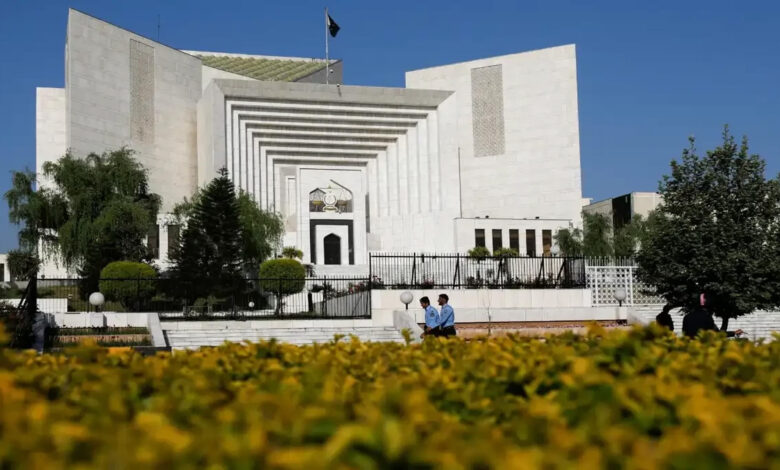
Islamabad:The Supreme Court of Pakistan continued the hearing today (Thursday) of a high-profile constitutional case concerning the transfer of judges between high courts. A **five-member bench** headed by **Justice Muhammad Ali Mazhar** presided over the proceedings.
During the session, **advocate Salahuddin Ahmed** argued that the Constitution clearly outlines the process for judicial transfers. He contended that a **permanent transfer** of a judge would undermine **Article 175-A**, which governs judicial appointments. He further noted that there is **no precedent** for a judge being permanently transferred from one high court to another, and that **Article 200** only allows for **temporary transfers**.


Salahuddin maintained that **permanent appointments fall under the exclusive jurisdiction of the Judicial Commission**, and **appointments and transfers are fundamentally different in nature**. He emphasized the need for **meaningful consultation** during the transfer process, asserting that the procedure in question lacked transparency and was merely symbolic.
He also pointed out that under **Section 3 of the Islamabad High Court Act**, only “appointments” are mentioned, with **no reference to transfers**, and cited **Judicial Commission Rule 6**, which uses the term “region.”
In response, **Justice Muhammad Ali Mazhar** observed that the case centers on the **interpretation of constitutional provisions**. He noted that three Chief Justices were involved in the matter, and that the process wasn’t entirely in the hands of the executive. He also stated that **judges’ consent** is typically taken for transfers, and **Article 175-A** does allow for new appointments.
The **Attorney General** informed the bench that the **minutes of the Judicial Commission meeting** are available for the court’s review. Salahuddin replied that he does not have access to those records. **Justice Naeem Akhtar Afghan** remarked that he would raise questions regarding the minutes at the end of the proceedings.
Justice Mazhar highlighted the **significance of the case**, saying it is a **first-impression matter** and that the court must set a precedent for the future. Salahuddin reiterated that the **Judicial Commission had not properly considered** the matter, and stressed that where the law is silent, no mandatory provisions can be added arbitrarily. He also revealed that the summary sent to the Prime Minister implied only one judge would be appointed in Punjab.
At the conclusion of the hearing, the court **adjourned proceedings until June 16**, with Justice Mazhar indicating that if arguments are concluded on that date, a **short order** will be issued after consultation.
Salahuddin urged the court to **complete the hearing by tomorrow**, but Justice Afghan clarified that **some bench members will not be available**. Salahuddin then suggested resuming the hearing later in the day, but Justice Mazhar noted that **rebuttal arguments include questions**, and **the hearing could not be concluded today**. **Justice Salahuddin Panhwar** agreed with this assessment.