Pakistan Downs Indian Rafale Jet Amid High Tensions: British Media Reports Detailed Account
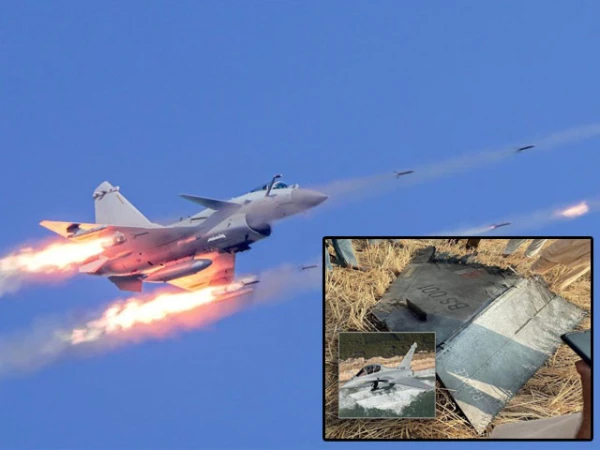
Islamabad: May 7 – In an unprecedented aerial skirmish between Pakistan and India, the downing of India’s state-of-the-art Rafale fighter jet stunned military circles around the world. British news agency Reuters has provided a detailed report shedding light on the technical aspects, the reasons behind the incident, and the intelligence failures that led to the dramatic event.**
### Background: Rising Tensions and Initial Attacks
The tensions between Pakistan and India had been escalating since the February attack on the Indian town of Pulwama, where 26 Indian tourists were killed. India, without providing any concrete evidence, blamed Pakistan for the attack. Pakistan strongly rejected the accusations. On the morning of May 7, India launched an airstrike on Pakistan in retaliation. In response, Pakistan displayed remarkable military maneuvering.
### Pakistan Air Force Chief on High Alert
According to Reuters, Pakistan’s Air Force Chief, Air Marshal Zaheer Ahmed Babar, had been monitoring the situation closely in the Air Operations Room for several days. As soon as several dozen Indian aircraft were detected on radar, the PAF chief immediately ordered the deployment of Chinese-made J-10C (Vigorous Dragon) jets, with explicit instructions to target Rafale jets.
### Chinese PL-15 Missile: A Game-Changer
One of the main factors that led to the destruction of the Rafale was a critical misjudgment by Indian intelligence regarding the range of the Chinese-made PL-15 missile. Indian pilots believed they were out of the range of Pakistani missiles, unaware that the PL-15 had a reach of over 200 kilometers. This missile was fired from the Pakistani J-10C jet, which ultimately led to the downing of the Rafale.
### Pakistan’s Electronic Warfare Strategy: A Fatal Blow to India
Pakistan didn’t just rely on missiles but also deployed a sophisticated “Kill Chain” system. Reuters reported that four Pakistani officials confirmed this network, which integrates sensors across land, air, and space, including the domestically developed Data Link-17 and a Swedish-made surveillance aircraft. This system allowed the Pakistani J-10C jets to remain undetected by enemy radar while receiving real-time data from the surveillance aircraft.
### Global Implications: France and China in the Spotlight
Following the downing of the Rafale, shares of the French company Dassault, which manufactures the Rafale jets, experienced a significant decline. Nations like Indonesia, which were initially planning to buy Rafale jets, have now shown interest in China’s J-10C fighter jets. Experts believe this could mark a major shift in global arms exports, with China benefiting from this incident.
### India’s Denial and France’s Acknowledgment
While India has officially denied the loss of the Rafale jet, the head of the French Air Force and top officials from Dassault confirmed in June that India had indeed lost a Rafale and two other aircraft, including a Russian-made Sukhoi.
### India’s Change in Strategy
After the defeat on May 7, India altered its air strategy. On May 10, the Indian Air Force launched strikes on nine Pakistani airbases and radar stations, including a surveillance aircraft. Despite repeated attempts, India’s BrahMos missiles failed to breach Pakistan’s defense system, leading to a ceasefire brokered by the United States.
### China’s Role and Cooperation
Reuters reported that following the humiliating defeat, Indian officials repeatedly claimed that Pakistan had received live input from China in the form of satellite and radar data during the conflict. However, Pakistan has firmly rejected these claims. Chinese Air Force Chief, Lieutenant General Wang Gang, visited Pakistan afterward and expressed interest in the use of Chinese weapons in the “Kill Chain” system.
### Indian MP Claims to Have Seen Rafale Crash
Indian Member of Parliament Amarinder Singh claimed to have witnessed the crash of the “BS001 Rafale” in Indian Punjab. He presented evidence of the incident in the Lok Sabha. However, the Indian government has yet to provide any official stance on the matter.
This incident marks a significant shift in the regional balance of power and highlights the evolving dynamics between Pakistan, India, and their respective allies.