How Do Astronauts Live in Space? The Fascinating Account from Eating and Sleeping to Using the Washroom
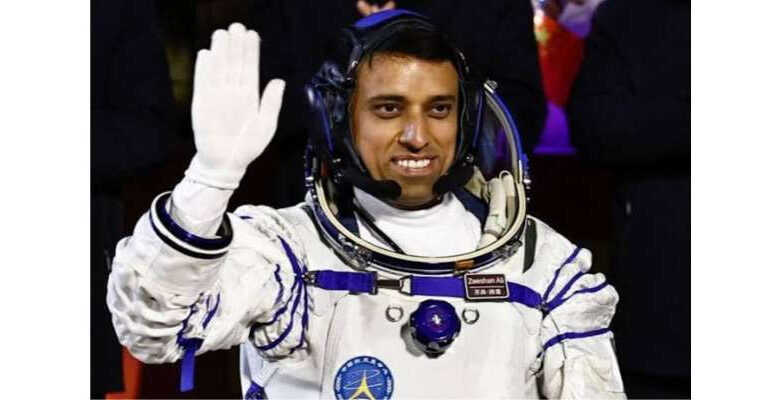
BEIJING (Daily Qudrat): After the successful arrival of Pakistani astronaut Muhammad Zeeshan Ali at China’s Tiangong space station, interest among the Pakistani public regarding life in space has increased. What do astronauts eat in space, how do they drink water, how do they use the washroom, where do they sleep, and how do they spend their time hundreds of kilometers away from Earth? These are the questions whose answers are extremely fascinating.
According to the news agency AFP, 40-year-old Pakistani astronaut Muhammad Zeeshan Ali, along with Chinese astronauts, has reached the Tiangong space station via the Shenzhou-24 mission, where his stay is expected to be about five days.
How much space is there inside the space station?
China’s Tiangong space station, orbiting at an altitude of about 400 kilometers from Earth, consists of three main parts.
Inside, about 110 cubic meters of space is available for astronauts to live and work.
The space station has designated areas for sleeping, eating, exercising, scientific experiments, and personal hygiene. The station is normally used for the accommodation of three astronauts; however, during crew changes, six astronauts can also stay here at the same time.
In space, instead of walking like on Earth, astronauts move from one place to another by floating in the air. Special handles installed on the walls help them move and maintain their position while working.
What do astronauts eat in space and how do they drink water?
According to the Chinese news agency Xinhua, about 200 types of food are available at the Tiangong space station, including rice, vegetables, meat, various traditional Chinese dishes, and desserts.
Food for astronauts is prepared in special packets. Some foods are dried and then water is added again, while prepared foods can be heated in special devices. There is also a modern hot-air oven on the space station for cooking food.
Drinking water from an ordinary glass is difficult in space because, instead of falling down, water begins to float in the form of small round droplets.
That is why astronauts drink water, tea, and other beverages through special sealed bags and straws.
Food particles must also be prevented from spreading in the air because they can damage sensitive equipment.
How do astronauts use the washroom and how do they bathe?
Using the washroom in space is quite different from on Earth.
According to NASA, the space toilet uses an air-pressure-based waste suction system instead of a traditional water flush, which works somewhat like a vacuum cleaner.
Special tubes and funnels are used for urination, while there is a separate arrangement for solid waste. Astronauts plant their feet at a designated place to sit so that they do not float in the air.
On space stations, water obtained from urine, sweat, and moisture in the air can be purified through modern machines and made reusable.
Bathing in the traditional way in space is also not easy. Astronauts use wet towels, special soap, and a shampoo that does not require much water to wash for body cleaning.
Sleeping without a bed, exercise, and leisure activities
Ordinary beds are not needed for sleeping in space. Astronauts sleep in special sleeping bags that are tied to a designated place so that during sleep their bodies do not float and collide with equipment.
During orbit around the Earth, astronauts can see the sun rise and set about 16 times in 24 hours, so a regular schedule for sleeping and waking is set.
During long stays in space, bones and muscles begin to weaken. To prevent this, astronauts exercise for about two hours or more every day. Special treadmills, exercise bikes, and other equipment are installed on the space station.
In their free time, astronauts can watch movies, listen to music, read books, and contact their families on Earth.
Looking at the Earth from the window and taking its pictures is also among the astronauts’ favorite activities.
Pakistani astronaut Zeeshan Ali will also perform various scientific experiments during his space stay, including assessing the possibilities of obtaining food and oxygen from microscopic water algae and the effects of the space environment on quinoa seeds.
The information obtained from these experiments can prove helpful in research for future long space travel and sustaining human life in space.