“Defence Pact Is Being Signed in Iran, the Defence Minister Is Sitting Here — Is There Interior Ministry Duty There Too?” Maulana Fazlur Rehman
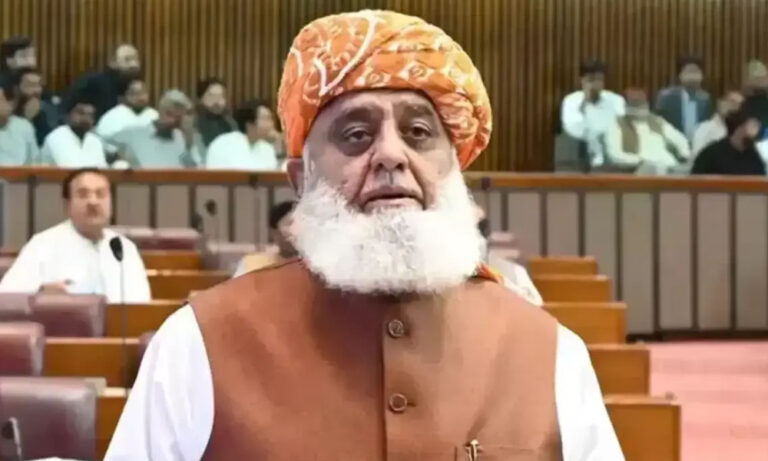
ISLAMABAD (Daily Qudrat): Jamiat Ulema-e-Islam (F) chief Maulana Fazlur Rehman, during his address in the National Assembly, pointed toward Defence Minister Khawaja Asif and said: “A defence pact is being concluded in Iran, a meeting is taking place, but the Defence Minister and Foreign Minister are sitting here in Pakistan. Is there Interior Ministry duty there too?”
JUI-F chief Maulana Fazlur Rehman accused the federal government of backtracking on an agreed understanding regarding PTI’s Islamabad long march, saying Prime Minister Shehbaz Sharif had asked him to play a role in ending the protest, but later the government changed its position and imposed emergency and Governor’s Rule in Khyber Pakhtunkhwa.

Addressing the National Assembly, Maulana Fazlur Rehman said that during the long march, PTI leaders contacted him and requested him to play a role in ending the political deadlock. After that, he held detailed discussions with Prime Minister Shehbaz Sharif and other political leaders to avert confrontation and bloodshed.
According to him, the Prime Minister had asked PTI to end the long march, while PTI was demanding access to its founder Imran Khan and facilities for his medical treatment. Maulana Fazlur Rehman claimed that he tried to bring both sides to an acceptable understanding, but later Deputy Prime Minister and Foreign Minister Ishaq Dar told him that the cabinet did not agree with the proposed procedure.
The JUI-F chief raised the question: if the government had expressed readiness to resolve the issue through negotiations, then why were extraordinary measures suddenly taken? He said political disputes should be resolved through negotiations and democratic procedure rather than the use of force.
Allegation of Misuse of the Constitution
Maulana Fazlur Rehman criticised the government for defending the imposition of emergency and Governor’s Rule, saying the mere existence of constitutional powers does not prove that any action is in accordance with democratic principles.
Referring to Articles 232 and 234 of the Constitution, he said the powers relating to emergency and Governor’s Rule should be viewed in the context of the overall spirit of the Constitution and the Objectives Resolution contained in Article 2A.
He said that if there are objections to the performance of a provincial government, the public mandate and democratic process should be respected instead of taking extraordinary measures to remove it. He alleged that the government used constitutional provisions for political purposes.
Questions Also Raised Over Balochistan’s Situation
JUI-F chief Maulana Fazlur Rehman also raised questions over the federal government’s counter-terrorism policy, saying that if the deteriorating law and order situation in Khyber Pakhtunkhwa can be the basis for extraordinary measures, then instability, abductions and other security issues in Balochistan should also be assessed on the same standard.
He asked whether the federal government has succeeded in maintaining law and order across the country. He said reports continue to emerge of the abduction of government officials and other important figures in Balochistan, while his party’s workers also face movement problems in some areas.
Maulana Fazlur Rehman also criticised the counter-terrorism policies continuing since the era of former military ruler Pervez Musharraf, saying that to assess the current situation it is necessary to consider the failures of those policies.
On the other hand, the federal government, defending its actions in Khyber Pakhtunkhwa, has taken the position that intervention was necessary due to growing militancy and the provincial government’s alleged lack of cooperation in counter-terrorism efforts. PTI has rejected the action as contrary to the province’s public mandate.
“Our Party Has Also Made Sacrifices”
Maulana Fazlur Rehman, rejecting allegations that his party takes a soft stance on terrorism, said JUI-F has struggled against militancy for decades, and during this its workers and supporters have sacrificed their lives.
He said hundreds of his party’s workers and supporters were killed in various attacks, while in an attack on a gathering, he said 90 of his colleagues were killed. He said these sacrifices should not be ignored on the basis of political differences.
He also accused the government of dividing political and religious forces, saying that to resolve national issues it is necessary to take all segments along.
Call for a New Charter of Democracy
Maulana Fazlur Rehman invited the government and opposition to sit at one table and agree on a new charter of democracy, saying a joint course of action is necessary to save the country from unconstitutional measures, political confrontation and violence.
He said the state should play the role of uniting the people instead of dividing them. According to him, suppressing political differences through force can increase resistance and tension.
The JUI-F chief said his party is ready to play its role for the supremacy of the Constitution and the protection of democratic rights, but the government and opposition must also return to negotiations.
He said in his address: “This country does not belong to any army or general — it belongs to all of us.” He said Pakistan’s future should be decided under the Constitution, public mandate and democratic principles rather than force.
Questions Regarding Defence and Foreign Ministers
During his address, Maulana Fazlur Rehman, referring to the presence of Defence Minister Khawaja Asif, raised questions over the negotiations in Tehran and the situation regarding the defence pact.
Speaking in the House, Maulana Fazlur Rehman said a defence pact is being concluded in Iran, a meeting is taking place, but the Defence Minister and Foreign Minister are sitting here in Pakistan. Is there Interior Ministry duty there too? He said that during decision-making and negotiations on important matters, it is necessary to ensure the presence of relevant officials and to keep national dignity in mind.
Looking toward Khawaja Asif, Maulana Fazlur Rehman repeated the remark about the Defence Minister — “there should be some shame, some modesty” — and his sarcastic remark drew laughter in the House. Khawaja Asif also smiled on the occasion.
جناب خواجہ آصف صاحب بھی تشریف فرما ہیں۔ دفاعی معاہدہ ایران میں ہو رہا ہے، دفاعی وزیر یہاں بیٹھا ہوا ہے۔کوئی شرم ہوتی ہے، کوئی حیا ہوتی ہے۔
مولانا فضل الرحمان کی گفتگو پر ایوان میں قہقہے https://t.co/A9OC9yrC0y
— Rizwan Ghilzai (Remembering Arshad Sharif) (@rizwanghilzai) October 28, 2026
Meanwhile, Speaker National Assembly Sardar Ayaz Sadiq said he would hear Maulana Fazlur Rehman’s speech, but unparliamentary words would be removed from the proceedings. The Speaker also expunged one sentence of his speech from the proceedings of the session.
At the end of his address, he once again urged the government and opposition to build a broad political understanding for the protection of national security, democracy and the constitutional system.