Owners of Orchards Used for Attacks on Security Forces Will Be Treated as Facilitators: Sarfraz Bugti
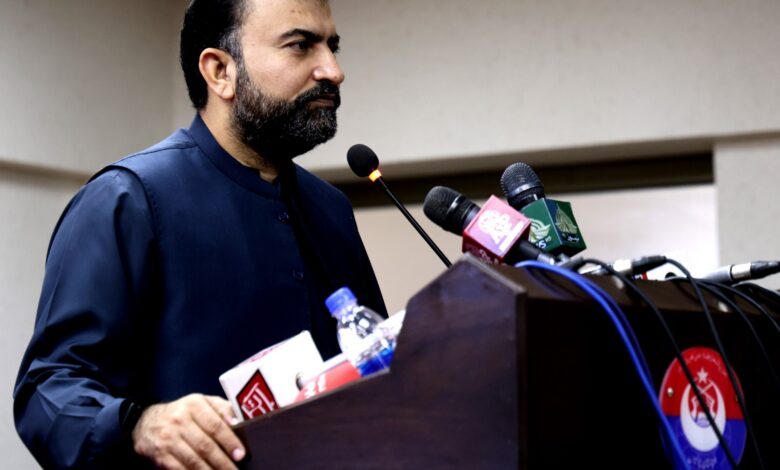
QUETTA: Balochistan Chief Minister Mir Sarfraz Bugti has warned that owners of private properties or orchards used to launch attacks on security forces or government officials will be considered facilitators of terrorism.
Speaking at a ceremony at the Central Police Office in Quetta, Bugti said the government was committed to improving governance through digitalization, which he said would enhance public service delivery and transparency. He also announced that a committee had been formed to investigate complaints regarding the recruitment of tehsildars through the Balochistan Public Service Commission, with its findings to be made public.


The chief minister said eight existing Balochistan Police applications had been upgraded and eight new applications introduced. These digital services include facilities for citizens, police complaints, travel and other areas, while a special application for women allows them to declare an emergency with a single click and immediately alert their parents and police.
Bugti said the government would launch an awareness campaign in universities and colleges to educate female students about the emergency application and other safety facilities. He also said the government was providing scholarships and other opportunities to girls, including plans involving international universities, as well as pink scooters and buses.
He announced a Rs5 million cash reward for the police and IT teams working on the digital initiatives and allocated Rs50 million for further digitalization of the Balochistan Police. He also appreciated the Punjab government and Punjab Police for their technical cooperation.
Discussing police reforms, Bugti said the government was working to improve police salaries and had already increased the pay of fighting forces, including the Anti-Terrorism Force, Counter Terrorism Department and Special Operations Wing. He said the government’s focus was on empowering the police to effectively combat terrorism and crime.
Regarding the security situation, the chief minister said Balochistan was facing an intelligence-based war and alleged that there was concrete evidence linking the unrest to India’s intelligence agency, RAW. He also claimed that modern weapons and military equipment left behind by NATO forces in Afghanistan had entered the black market and were being used by terrorist elements.
Bugti said more than 1,000 hardcore terrorists had been neutralized during the past year, adding that the state’s counterterrorism response had also been strengthened. He described the situation as guerrilla warfare and said the state would not become exhausted in its fight against terrorism.
On attacks allegedly launched from orchards in Mastung, Bugti said the government did not want innocent civilians to suffer because terrorists often used people as human shields. However, he warned that the state’s patience had limits.
He said if security forces or the provincial interior minister were attacked from an orchard, its owner could not simply claim ignorance about the presence of terrorists on the property. If private property was used for terrorism, he said, its owner would also be considered a facilitator.
The chief minister warned that if the use of private properties for terrorist activities continued, the government could consider relocating residents from such areas or eliminating orchards being used for attacks. He stressed that the lives of Pakistan Army, Frontier Corps and police personnel were extremely valuable and that the government would not tolerate attacks originating from private property.
On recruitment, Bugti said an internal error had been identified in the tehsildar recruitment process and a committee had been formed with the Public Service Commission to investigate the matter. The committee is expected to submit its report within seven to 10 days, after which the findings will be shared with the media and public.
Reiterating his government’s policy of “merit, merit and merit,” Bugti said no compromise would be made on merit, whether in Public Service Commission recruitment or through the artificial intelligence-based testing system.
He said merit-based governance was essential to reconnect young people with the state and counter attempts to alienate them through propaganda.
Bugti added that he was willing to bear political losses if necessary to uphold merit. He said the state was more important to him than any political interest and described merit as the key to good governance.