System Was Deliberately Destroyed; Pakistan Needs a Political, Not Non-Political Reset: Bilawal Bhutto
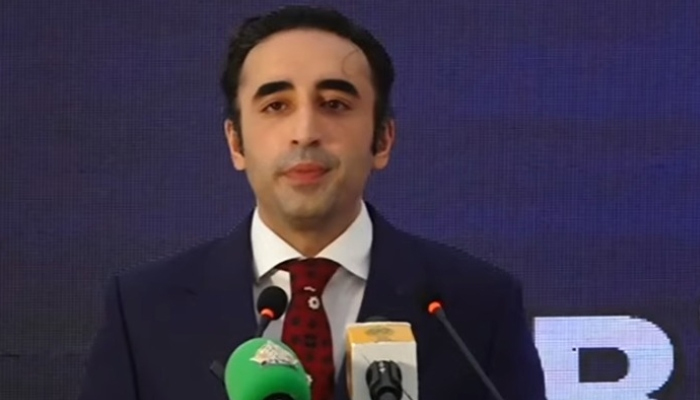
KARACHI: Pakistan Peoples Party (PPP) Chairman Bilawal Bhutto Zardari has said that the country’s system was not destroyed on its own but was deliberately pushed towards collapse, stressing that Pakistan needs a political reset rather than a non-political intervention.
Addressing a press conference at the Karachi Press Club, Bilawal said the system had virtually collapsed, but no one was willing to discuss the reasons behind its deterioration.
He said the system needed to be reset to ensure that everyone received their due rights, adding that he also shared responsibility for its collapse.
“We need a political reset, not a non-political one,” he said, adding that the process should begin with parliament.
Bilawal acknowledged that the opposition had completely lost confidence in parliament and said restoring that confidence was primarily the government’s responsibility.
Political prisoners must be released, says Bilawal
The PPP chairman said political prisoners would have to be released, adding that this would eventually happen, if not today then tomorrow.
He suggested that the government should approach the Pakistan Tehreek-e-Insaf (PTI) and hold talks with the party. If PTI agreed to cooperate in the fight against terrorism, the imposition of governor’s rule could be brought to an end, he added.
Government should restore Fazlur Rehman’s confidence
Commenting on Jamiat Ulema-e-Islam-Fazl (JUI-F) chief Maulana Fazlur Rehman, Bilawal said it was the opposition’s responsibility to criticise the government.
He said the government should make efforts to restore Fazlur Rehman’s confidence, reminding the ruling coalition that it would not have been in power without the role the JUI-F chief played in the Pakistan Democratic Movement (PDM).
Bilawal called for an end to political victimisation and retaliatory actions against opposition leaders.
27th Amendment passed through forced majority: Bilawal
Speaking about constitutional amendments, Bilawal alleged that two amendments had been passed after seats were taken away from the opposition and said the government was now preparing to bring a third.
He said the 26th Constitutional Amendment had been passed through mutual understanding despite the absence of complete consensus, whereas the 27th Amendment was approved through a forced majority rather than consensus or mutual agreement.
Bilawal said several senior judges resigned following the passage of the 27th Amendment, arguing that their resignations reflected a loss of confidence in the system.
He stressed that restoring public trust in state institutions should be the first priority, saying every institution that had lost public confidence needed to regain it.
Parliament and media must be strengthened
Bilawal described parliament and the media as two of the country’s most important institutions, saying parliament was Pakistan’s most powerful forum and should allow open disagreement on every issue.
He said differences of opinion were essential to parliamentary democracy but regretted that the opposition no longer had confidence in the parliamentary system. He reiterated that the government carried the greatest responsibility for restoring that trust.
The PPP chairman also said the media had perhaps never been as weak in the country’s history as it was today.
He questioned how journalists could perform their duties effectively if they feared action for speaking the truth, adding that journalists must have the freedom and authority they were entitled to exercise.
Bilawal concerned over worsening economic conditions
Expressing concern over the economy, Bilawal said he had never witnessed such difficult economic conditions in his lifetime.
He questioned how ordinary citizens could survive as inflation continued to rise and voiced particular concern about the future of poor and underprivileged segments of society.
He said politicians had forgotten the problems of the people and were focusing on politics of hatred and division instead of addressing public concerns.
Bilawal also described corruption as one of Pakistan’s fundamental issues, alleging that there was little genuine interest among political stakeholders in eliminating it.


