Balochistan Needs More Administrative Units, Better Local Government System and Additional Resources: CM Mir Sarfraz Bugti
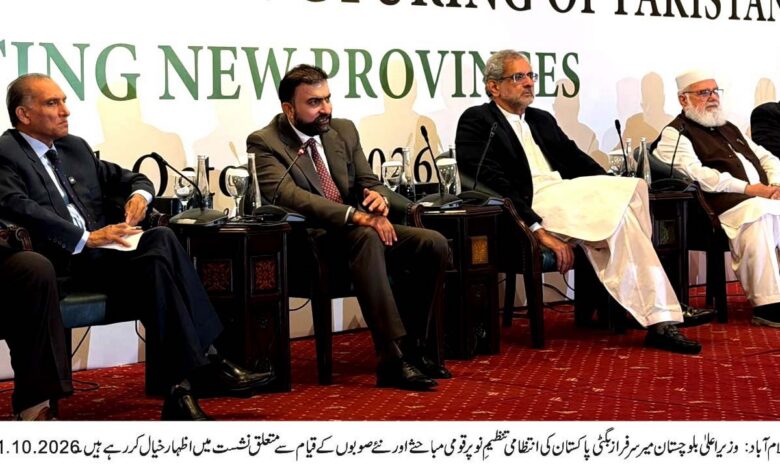
ISLAMABAD (Quadrat Daily) — Balochistan Chief Minister Mir Sarfraz Bugti has said that to effectively address the governance challenges facing Balochistan, improve the provision of basic facilities to the people and take administrative affairs to the people’s doorstep, the province needs more administrative units, an effective local government system and additional resources. Running a province as vast as Balochistan effectively while sitting only in Quetta is a major administrative challenge, which is why there is a need for administrative reorganisation at the national level, the creation of new provinces and a serious review of existing governance models. He said the start of a national dialogue on this matter is welcome, but it is essential that this debate not be confined to seminars and hotels and instead be taken to Parliament to build a broader political consensus. He expressed these views while speaking at a national debate on Pakistan’s administrative reorganisation and the creation of new provinces organised by the Sanober Foundation.
The chief minister said that for several months a debate has been ongoing in Pakistan on restructuring or maintaining existing governance models, which is a positive development. This national dialogue must assess the extent to which Westminster-style democracy is delivering the desired results to the people, and whether the current arrangement of administrative divisions and geographical areas is also hindering the effective delivery of public services. We must examine whether the current division of administrative units is itself causing the difficulties for which a system is being deemed a failure. Explaining the difference in geographical size between Balochistan and other parts of the country, Mir Sarfraz Bugti said that when his friends and colleagues from Punjab start their journey from the Wahga border and reach Shahwali near Rajanpur, Punjab’s territory ends, and this journey takes about six to seven hours. By contrast, travelling from one place to another within a single district of Balochistan can take ten hours. This difference is enough to understand the province’s geographical spread and administrative needs. He said the need for administrative reforms in Balochistan must be viewed in the context of this ground reality.

The chief minister said political consensus is essential first for reforms of this nature. National debates and seminars can play an important role in this direction, but their real utility will emerge only when this debate reaches Parliament and political parties sit together and agree on a workable solution. He said in clear terms that Balochistan needs not only more provinces or administrative units but also the making of the existing provincial administrative structure more effective in line with public needs. Referring to an incident from his tenure as interior minister, Mir Sarfraz Bugti said a suicide attack took place at a shrine near Saruna, a remote area of Khuzdar, in which several innocent people were killed. After the incident, an anchorperson in Lahore or Islamabad contacted him and asked why the deputy commissioner had not yet reached the site. The chief minister said the relevant deputy commissioner needed about nine hours to reach the site from the district headquarters. He said when an administrative officer has to travel nine hours to respond to an emergency within his own district, it points to the fundamental problem between the administrative structure and geographical distances.
He said under the National Finance Commission (NFC), population is given primary importance in the distribution of resources, but factors such as administrative needs, geographical size and access to services for the people should also be given due importance. The chief minister said when he took charge of the provincial government, the number of divisions in Balochistan was eight, which has been increased to twelve, while the number of districts has been increased from about 36 to 41. These steps aim to ease administrative affairs by dividing large districts into smaller administrative units and to provide the people better access to government services. He said the provincial government has taken possible steps under its administrative powers, but constitutional amendments and other major decisions will require broader political consensus.
Regarding the local government system, the chief minister said the lack of resources is an important issue in its own right, but a local government system currently exists in Balochistan. He said to his knowledge Balochistan is among the few provinces where the local government system is functional, though he clarified that he does not have a complete picture of the current situation in other provinces. He said the current term of local government institutions in Balochistan is ending on 8 February and the provincial government has already written to the Election Commission of Pakistan requesting that a date be given immediately for holding local government elections so the democratic process can continue.
On Balochistan’s representation in national politics and the attention of mainstream political parties, the chief minister said he himself belongs to a mainstream political party and is grateful for the respect and confidence his party has given him, but it is also necessary to review the proportion of the country’s political priorities and representation. He said the number of MNAs elected from Balochistan is less than the representation of each of the Gujranwala, Lahore and Faisalabad divisions. According to him, this situation requires mainstream political parties to understand Balochistan’s problems, needs and development priorities more seriously.
Mir Sarfraz Bugti said the primary responsibility of politicians is legislation, but Pakistan’s political process has largely been reduced to winning votes on the basis of drains, roads and local development works. He said when the focus of politics becomes primarily local development projects, attention to legislation, policymaking and major national issues is affected. Therefore, it is necessary to strengthen the local government system so that local-level issues are resolved by elected local representatives and provincial and national elected representatives can focus on legislation and broader policy matters.
At the conclusion of his address, the Balochistan chief minister said Balochistan needs the serious attention of mainstream political parties, national media, intellectuals, all relevant state institutions and especially the bureaucracy. He stressed that statements alone are not enough to resolve the province’s problems; effective reorganisation of the administrative structure, the creation of more administrative units, a strong and functional local government system and the provision of appropriate resources keeping in view the province’s geographical size and needs alongside population are imperative. He said giving Balochistan’s administrative and development needs their proper place in national policymaking is the need of the hour.