Mahrang Baloch Repeatedly Refused to Be Part of Negotiations, Security Officials Brief Journalists

Quetta – According to Express News, security officials have said that peace in Balochistan will come through negotiations, not bullets. A special session was held between security officials and Pakistan’s media representatives. A senior security official called for adopting a new political and strategy-based approach for Balochistan, saying that peace in Balochistan will come through dialogue, not guns. The province’s complex problems cannot be resolved through the use of force alone, and the way forward lies in continuous engagement with ordinary Baloch people.
The official said that dialogue is now being held with ordinary people, not tribal chiefs (sardars). Last year, 54,000 contacts were made with the public, and 34,000 this year. Speaking to a delegation of journalists on Friday, the security official said, “We have to win peace in Balochistan, not war. This issue will be resolved through negotiations, not bullets.” He said the real issue is one of narrative. Although the challenges facing Balochistan were serious, they were not insurmountable.
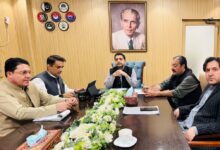
He said Pakistan needs a long-term strategic vision for the province, including a 10-year plan, instead of relying on short-term solutions to security crises. He said there is no traitor in Balochistan; 99.9 percent of people are as patriotic as those in other parts of Pakistan. He acknowledged that the people of the province had genuine grievances, but some concerns were being exaggerated or exploited for political purposes. “We respect these grievances,” he said.
He stressed that the state should talk to ordinary people rather than the elite and sardars who exploit the situation for their own interests. Officials said that last year, approximately 54,000 meetings were held with the people of Balochistan, and another 34,000 this year. “We talk to the people, not the sardars,” he said.
The security official identified political deprivation, along with economic deprivation, as one of the main problems facing Balochistan. He pointed out that despite comprising nearly half of Pakistan’s land area, the province has only 16 seats in the National Assembly. He asked when a major political party last held a public gathering in Balochistan. He said the absence of mainstream political parties has created a vacuum that social movements and narratives nurtured through social media are rapidly filling. He argued that Baloch representation in Parliament is low.
The official also blamed elite capture and corruption for preventing available financial resources from translating into development. He also said that a large part of the province’s economy has historically remained outside the formal system. He said the government needs to prepare a strategic vision for the province and answer a fundamental question: when will Balochistan develop?
The official described Balochistan as a center of emerging competition over strategic resources and argued that the province’s mineral wealth and geographic location have made it vulnerable to rivalry among regional and international powers. Referring to the China-Pakistan Economic Corridor (CPEC), mining and minerals, and the province’s strategic location, he said Balochistan is Pakistan’s future. He claimed the province has huge reserves of gold, copper, and rare minerals, with an estimated potential value of approximately 6 trillion dollars. He also mentioned the province’s fisheries, gas reserves, and other natural resources, which remain major untapped economic opportunities. He said the Saruna Block has gas reserves several times larger than Sui, but work has been halted due to tribal opposition.
The official said that wherever large natural resources are discovered, competition and instability often arise. Efforts are being made to harm CPEC and exploit local grievances. He described Balochistan as a victim of competition among major powers and said regional rivalries have further complicated the situation.
The official further said that those who take up arms against the state will continue to be dealt with through security operations, but stressed that there must also be a political solution alongside military action. The broader goal is to bring people into the political mainstream.
The official identified four broad categories of threats: kinetic terrorism, non-kinetic activities including social media campaigns, sub-kinetic activities, and socially disruptive proxies. He said terrorist networks with foreign backing are active against Pakistan. He revealed that Baloch terrorist leader Dr. Allah Nazar is hiding in one of the neighboring countries. He said Pakistan has requested the return of wanted terrorists, and red notices have been issued against several terrorists.
The official linked the recent surge in terrorism in Balochistan and elsewhere to developments following the US withdrawal from Afghanistan, saying the current year has been the deadliest phase of terrorism in Balochistan in recent years. He said 1,263 terrorists have been killed this year. He noted significant improvement in anti-smuggling operations, saying that previously approximately Rs 1.2 trillion worth of smuggling was taking place through Balochistan, but now about 90 percent of it has been stopped. Iranian oil smuggling has dropped dramatically from approximately 20 million liters per day to about 1 million liters.
The official said security measures alone cannot produce sustainable peace. He called for a policy shift combining political engagement, development, security, and diplomacy. He said diplomatic activity, particularly with Iran and Afghanistan, also needs to be activated to bring wanted terrorists and those involved in terrorism to justice. He added that the state has reached out to people across Balochistan and will continue to do so. “Embrace Balochistan. If there is resistance, embrace it even more strongly,” he said. He acknowledged that the state has yet to find a political solution to the crisis but stressed that winning over ordinary Baloch people is ultimately the key to success. “We will win when we win over the ordinary Baloch,” he said.
The official said efforts were made to include Mahrang Baloch in dialogue, but she repeatedly refused to be part of negotiations.
Regarding the law and order situation in Balochistan, security sources said it is being gradually improved, with phased progress ongoing on a 10-year plan. According to security sources, approximately 7.7 billion dollars worth of weapons were left behind after the US withdrawal from Afghanistan. The government had also previously adopted a policy of negotiating with terrorist elements. Some elements were brought down from the mountains, but they later disappeared again of their own accord.
On the issue of missing persons, security officials said the Balochistan government has enacted legislation under which any person taken into custody will be produced in court the next day. Detainees are also allowed to meet their families every 15 days. State policy is now moving from “sardar to government.” Direct contact is being made with the public in every district, and district coordination committees have also been established.
According to security sources, various development projects are ongoing for the people of Balochistan. Students from the province are also being given scholarships to study in other provinces of the country. Regarding Gwadar and CPEC, security officials said Chinese experts have their own design, and there is a plan to make Gwadar fully operational in the coming years. The cases of those who do not accept Pakistan’s Constitution will be decided in courts.
On mines and minerals, security sources said a 50 percent shareholding principle has been set in Balochistan in accordance with international standards, under which the mining company will get 50 percent, while of the remaining 50 percent, 25 percent will go to the provincial government and 25 percent to the federal government. Terrorist leaders Bashir Zeb is in Afghanistan while Allah Nazar is in Iran. In the region, Turkey is a country that is not causing any kind of disturbance in Balochistan. Pakistan will move forward in relations with every country by prioritizing its national interests.
Regarding administrative reforms, security sources said it has been decided to declare all areas of Balochistan as “A Area” and abolish “B Area.” Regarding the Levies system, officials claimed that of the approximately Rs 100 billion budget allocated for Levies, more than half allegedly went into the pockets of sardars, which is why the police system is being strengthened.
Reforms are also ongoing in Balochistan’s health sector. According to security sources, hospitals in the province are being improved, and non-functional medical centers are being made operational by repairing faulty machinery. The number of security forces in Balochistan has increased from 92,000 to 112,000. Approximately 5,000 individuals belonging to the BLA, BLF, TTP, and Fitna al-Hindustan are active in Balochistan, moving between Afghanistan and Iran. The number of MNA seats in the province should be increased, because low representation in the National Assembly creates a sense of inferiority.
According to security officials, after the Maarka Haq event, 21,000 people gathered in the stadium, which is a sign of public attachment to the state. The law and order situation in Balochistan is being gradually improved, and a 10-year plan has been devised for this purpose, on which phased implementation will continue.