US Midterm Elections Become a Multi-Million-Dollar Betting Market as Gamblers Wager on Political Outcomes
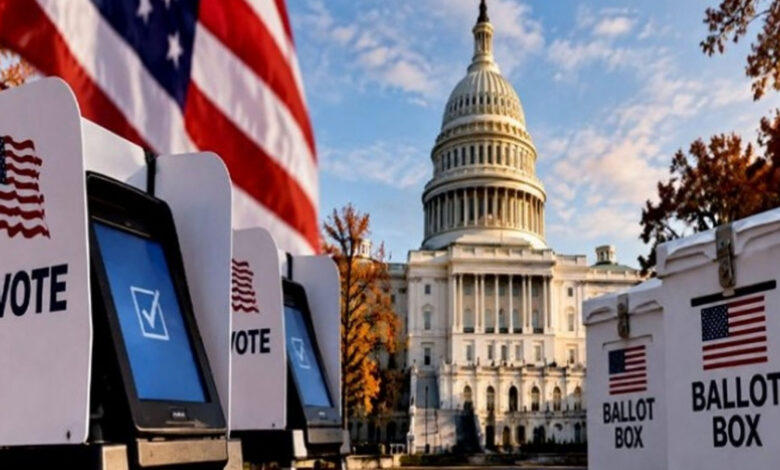
WASHINGTON:Betting on wins and losses in sports is nothing new, but in the United States, politics has increasingly become a major gambling market. Ahead of the November 3 midterm elections, millions of dollars are being wagered on the outcomes of elections for Congress, the Senate and state governorships.
Alongside election campaigns, activity on prediction markets has also intensified, with traders placing large bets on individual candidates, which political party will secure a majority and various possible election outcomes.

One of the most prominent platforms for political betting in the United States is Kalshi, which operates under the supervision of the US Commodity Futures Trading Commission (CFTC). Although commonly described as political betting or gambling, Kalshi classifies its products as event contracts that can be bought and sold.
According to the latest available figures, approximately $454.2 million was traded across Kalshi’s broader election-related markets during the past 30 days. On October 31 alone, around $38.3 million was wagered in a single day.
These figures include election markets beyond the November 3 US midterm elections and should not be interpreted as the total amount wagered exclusively on the midterms.
On November 3, elections will be held for all 435 seats in the House of Representatives, 35 Senate seats and 36 governorships across the United States.
Several races are particularly competitive, attracting substantial financial activity on prediction markets alongside attention from traditional opinion polls.
**Billions of Dollars in Political Expectations**
A Kalshi market concerning control of the House of Representatives recorded approximately $177.6 million in trading volume. A recent assessment showed traders assigning Democrats a 93 per cent probability of controlling the House, compared with 7 per cent for Republicans.
In the market concerning overall control of the Senate, approximately $133.9 million was recorded, with Democrats given a 72 per cent chance of securing control and Republicans 28 per cent.
Another separate Senate-related market recorded approximately $25.5 million in trading volume. These are separate markets, and their figures should not be treated as a single wager.
The figures highlight a growing dimension of American politics, where election outcomes have become important not only for political parties, candidates and voters but also for traders risking their money on the results.
**Texas Senate Race Attracts Major Betting Interest**
One of the most closely watched contests is the Texas Senate race, where Democratic candidate James Talarico is facing Republican candidate Ken Paxton.
According to Kalshi, approximately $68.5 million has been traded on this particular contest. In a recent market assessment, traders assigned Talarico a 69 per cent chance of winning, compared with 31 per cent for Paxton.
Interestingly, Texas is traditionally considered a Republican-leaning state, but its Senate race has attracted considerable national attention this year. Differences between prediction-market probabilities and conventional opinion polls have also drawn the attention of political analysts.
In the Texas gubernatorial election, Republican incumbent Greg Abbott is competing against Democratic candidate Gina Hinojosa.
Kalshi traders have assigned Abbott a 66 per cent chance of victory and Hinojosa 34 per cent, showing that market expectations differ between the state’s separate Senate and gubernatorial contests.
**Senate Races in Other States**
Apart from Texas, Senate contests in Maine, Ohio, Michigan, Iowa and Kansas have also attracted considerable betting interest.
In Maine, approximately $16.5 million has been traded on the contest between Democratic candidate Troy Jackson and Republican Senator Susan Collins. A recent market assessment assigned Jackson a 69 per cent chance of victory and Collins 31 per cent.
Other closely watched Senate contests include Abdul El-Sayed versus Mike Rogers in Michigan, Sherrod Brown versus Jon Husted in Ohio, Josh Turek versus Ashley Hinson in Iowa, and Adam Hamilton versus Roger Marshall in Kansas.
Trading prices in these states continue to fluctuate in response to opinion polls, campaign developments and statements by candidates.
**Governors’ Elections Also Attract Millions**
The betting activity is not limited to congressional and Senate races. Elections for governors in 36 of America’s 50 states are also attracting significant interest.
In Ohio, approximately $7.6 million has been traded on the contest between Democratic candidate Amy Acton and Republican Vivek Ramaswamy. Acton has been assigned a 79 per cent chance of winning, compared with 21 per cent for Ramaswamy.
In Florida, the contest between Republican Byron Donalds and Democrat David Jolly has also attracted attention, while gubernatorial races in Georgia, Nevada, Kansas and other competitive states remain on traders’ radar.
**How Does Betting Work on Kalshi?**
The process on Kalshi involves purchasing a contract based on whether a particular election outcome will happen.
For example, if a trader purchases a contract predicting a candidate’s victory for 70 cents and that candidate wins, the contract becomes worth $1. After deducting the purchase price and applicable fees, the trader earns a profit.
However, if the prediction is incorrect, the contract becomes worthless, resulting in the loss of the entire amount invested, along with any applicable fees.
This allows traders to take positions both for and against a candidate’s victory. Contract prices fluctuate throughout the election campaign as new opinion polls, candidate statements and political developments emerge.
There is an important distinction between market probabilities and actual election results.
A 70 per cent probability displayed on Kalshi does not mean that a candidate is expected to receive 70 per cent of the votes. It represents the market price at a particular moment, reflecting traders’ expectations, and can change before the results are announced.
Similarly, $50 million in trading volume on a particular market does not mean that the entire amount has been placed on one candidate’s victory. The figure can include contracts traded in different directions and repeated buying and selling of the same contracts.
**Political Betting Sparks Debate**
The growing popularity of prediction markets in American politics has sparked a debate over their impact on the democratic process.
Supporters argue that these markets combine different sources of information and expectations into market prices, providing an additional indicator of the political landscape.
Critics, however, argue that such platforms could increase the influence of wealthy investors and turn the democratic process into a game of financial gains and losses.
Once election results are announced, traders who make correct predictions stand to earn profits, while those who make incorrect predictions lose their investments.
As November 3 approaches, American voters will be preparing to decide the future composition of Congress, the Senate and state governments. At the same time, traders across prediction markets will be closely watching the results, with millions of dollars in potential profits and losses hanging in the balance.
Clarify the election date wordingTighten repetitive market explanations