Dilapidated Railway Infrastructure Triggers Rise in Train Accidents Across Pakistan
LAHORE: Pakistan Railways is facing growing concerns over its aging and deteriorating infrastructure as a series of train accidents in recent months, coupled with flood-related damage, have disrupted rail services and raised serious questions about passenger safety and operational efficiency.
Despite operating at significantly reduced speeds, both passenger and freight trains have increasingly been involved in accidents, putting the lives of passengers and railway employees at risk while also jeopardizing the transportation of goods worth billions of rupees.


According to reports, four to five major incidents over the past two months have sounded alarm bells for Pakistan Railways. The situation has been further aggravated by recent flooding, which has temporarily suspended rail services connecting Faisalabad with Karachi and several other cities, leaving thousands of passengers stranded and causing the railway administration to incur daily losses worth millions of rupees.
Much of Pakistan Railways’ infrastructure dates back nearly 150 to 200 years and is reportedly in a severely deteriorated condition. Owing to the fragile state of the railway tracks, trains are compelled to operate at reduced speeds. Attempts to increase speeds have, in some cases, resulted in derailments or collisions with stationary trains.
Information obtained by Express News indicates that the country’s aging rail network has become increasingly vulnerable due to wear and tear, resulting in average delays of 10 to 12 hours in train departures and arrivals. Passengers are often forced to endure prolonged journeys in extreme weather conditions, while train drivers face mounting operational challenges.
Pakistan Railways operates approximately 2,000 kilometers of railway track, of which nearly 1,100 kilometers are currently subject to engineering speed restrictions. Train drivers have been instructed to operate well below the designated “book speed” limits because of safety concerns arising from the deteriorating condition of the tracks.
Although the prescribed maximum speed for passenger trains is 110 kilometers per hour, trains on many routes are unable to exceed speeds ranging between 55 and 78 kilometers per hour. Railway officials acknowledge that if trains approach higher speeds on vulnerable sections of the network, the risk of derailments and other accidents significantly increases.
The rail network from Karachi to Peshawar has suffered extensive deterioration at multiple locations and requires continuous maintenance to remain operational. The Sukkur-to-Karachi section is reportedly among the worst affected, with more than 100 engineering restrictions imposed on both passenger and freight services. Average operating speeds on this section range between 30 and 50 kilometers per hour.
In contrast, sections connecting Multan, Lahore, Rawalpindi, and Peshawar permit speeds of between 78 and 100 kilometers per hour in certain areas, although drivers are often required to slow down because of safety restrictions.
Officials and railway sources have attributed the delayed modernization of the rail network partly to the prolonged postponement of the ML-1 railway upgradation project envisioned under the China-Pakistan Economic Corridor (CPEC). Since 2015, large-scale track modernization work has reportedly remained stalled pending the project’s implementation.
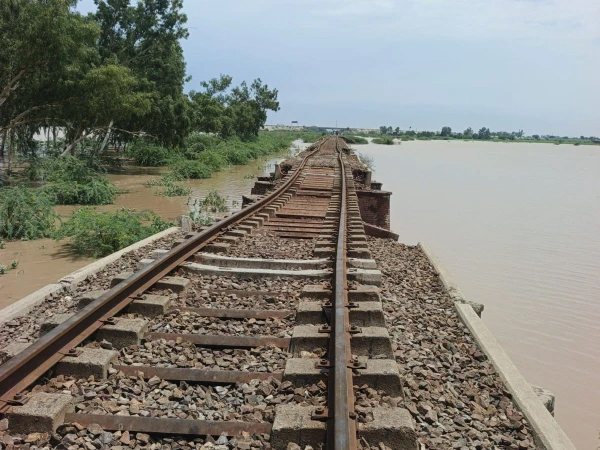
The deteriorating infrastructure has also forced Pakistan Railways to cancel services periodically and accommodate passengers on alternative trains where possible. Recent flood damage near Qila Sattar Shah has further disrupted operations after a portion of a railway bridge was washed away, suspending train services for thousands of passengers traveling between Faisalabad, Lahore, and Karachi. Restoration work has yet to begin because of the prevailing flood conditions.
Meanwhile, critics have argued that greater attention is being devoted to railway station upgradation projects than to the modernization of the railway tracks themselves.
Responding to these concerns, Federal Minister for Railways Hanif Abbasi stated that Pakistan Railways generated a record revenue of Rs115 billion despite the challenging circumstances. He said agreements worth billions of rupees have been finalized with domestic and international financial institutions and that railway development projects are being undertaken in collaboration with provincial governments.
The minister announced that work on infrastructure development projects worth billions of rupees in the Karachi-Sukkur division is expected to commence during the current year. He added that major railway stations in Lahore, Karachi, Faisalabad, and Rawalpindi have already been upgraded and that efforts are underway to improve passenger services, ensure timely arrivals, and introduce modern facilities.
Hanif Abbasi further noted that train operations are also being expanded under public-private partnership arrangements, enabling passengers to benefit from improved seating arrangements and enhanced onboard catering services.
The recent spate of accidents and infrastructure challenges has renewed calls for comprehensive modernization of Pakistan’s railway network to ensure safer, faster, and more reliable rail transportation across the country.