Forced Division of Sindh Will Lead to Bloodshed on Karachi’s Streets, Warns Bilawal Bhutto
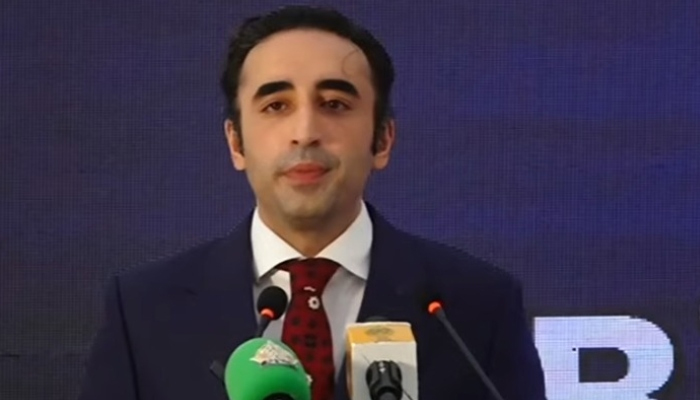
KARACHI: Pakistan Peoples Party (PPP) Chairman Bilawal Bhutto Zardari has warned that any attempt to divide Sindh through coercion would lead to bloodshed on the streets of Karachi, saying those responsible would be held accountable.
Addressing a “Meet the Press” event at the Karachi Press Club, Bilawal said forcibly creating a new province by dividing Sindh would deepen social divisions and turn them into lasting enmity.


“If Sindh is divided by force, questions will be asked about the bloodshed on Karachi’s streets,” he warned, adding that ordinary people could take up arms and the violence would not remain limited to a single incident.
He cautioned that forced division could lead to a situation in which brothers in Sindh would turn against and kill one another. He said he could not accept bloodshed and supported the creation of new provinces only when they reflected the will and consent of the people and followed constitutional and legal procedures.
Bilawal said the PPP supported the creation of provinces in accordance with public wishes, the Constitution and the law. He rejected the suggestion that a referendum was necessarily the solution, arguing that the real issue was the intention behind such proposals.
He said referendums had historically been used in Pakistan to legitimise undemocratic actions and maintained that the Constitution already provided a procedure for creating new provinces. Raising proposals outside that framework, he argued, amounted to searching for an unconstitutional route.
Pakistan needs a political reset, not a non-political intervention
Bilawal said the country’s system had not collapsed on its own but had been deliberately pushed towards destruction. He acknowledged that the system had virtually broken down and said he also shared responsibility for its collapse.
He called for a political reset, insisting that the process must begin with parliament rather than through non-political intervention.
According to Bilawal, the opposition had completely lost confidence in parliament, and restoring that confidence was primarily the government’s responsibility.
He also called for the release of political prisoners, saying the matter would have to be addressed sooner or later.
The PPP chairman said the government should engage with Pakistan Tehreek-e-Insaf (PTI). If the party was willing to cooperate in the fight against terrorism, governor’s rule could be withdrawn, he added.
Bilawal said he considered PTI founder Imran Khan a political prisoner. He questioned whether every former prime minister who had been sent to jail was actually a thief or whether such cases reflected political victimisation.
“I want to see a day when someone becomes prime minister and does not have to go to jail afterwards,” he said.
Government should restore Fazlur Rehman’s confidence
Commenting on Jamiat Ulema-e-Islam-Fazl (JUI-F) chief Maulana Fazlur Rehman, Bilawal said it was the opposition’s responsibility to criticise the government.
He urged the government to make efforts to restore Fazlur Rehman’s confidence, recalling that the ruling coalition would not have been in power without the role the JUI-F leader had played in the Pakistan Democratic Movement (PDM).
Bilawal called for an end to retaliatory political actions and said criticism of the government should not be met with pressure or persecution.
27th Amendment passed through forced majority: Bilawal
Speaking about constitutional amendments, the PPP chairman alleged that two amendments had been passed after seats were taken away from the opposition and said the government was now preparing to bring a third.
He said the 26th Constitutional Amendment had been passed through mutual understanding despite the absence of complete consensus, whereas the 27th Amendment was approved through a forced majority rather than agreement or mutual consent.
Bilawal said several senior judges resigned after the passage of the 27th Amendment, arguing that their resignations reflected a loss of confidence in the system.
He stressed that restoring public trust in state institutions must be the first priority, adding that every institution that had lost public confidence needed to regain it.
Prime Minister should have authority to control ministers
Bilawal said he wanted the judicial system to focus on its constitutional responsibilities rather than become involved in projects such as building dams.
He questioned the rationale of prescribing a different treatment for a problem, saying that a proper solution required addressing the actual issue.
He also criticised the manner in which discussions about provincial matters were being conducted, claiming that the issue had not been debated even in the federal cabinet, let alone parliament.
Bilawal said the PPP had made Shehbaz Sharif prime minister and that he wanted him to succeed. However, he added that the prime minister should have sufficient authority to keep his ministers under control.
He said decisions taken through backdoor channels could not last permanently, adding that neither the prime minister nor the cabinet had discussed any proposal concerning the provinces.
Media weaker than ever, journalists must have freedom
The PPP chairman said the country’s media might never have been as weak as it was today.
He questioned how journalists could perform their duties if they feared government action for speaking the truth, adding that media professionals should have the authority and freedom to which they were entitled.
Bilawal voices concern over economic hardships and corruption
Bilawal said he had never witnessed such difficult economic conditions in his lifetime and questioned how ordinary people could survive as inflation continued to rise.
He expressed particular concern about the future of poor and underprivileged communities, saying politicians had forgotten public problems and were instead engaged in politics of hatred and division.
He described corruption as one of Pakistan’s fundamental problems and alleged that political stakeholders showed little interest in eliminating it.
He also said public confidence in elections could not be restored until people trusted the Election Commission of Pakistan.
Bilawal alleged that one of the easiest ways to engage in corruption in Pakistan was to align oneself with the state, claiming that those who enjoyed such backing faced little accountability.
He cautioned against branding political criticism as evidence of corruption or hostility towards the country.
Federal government responsible for provincial financial shortfalls
Responding to the debate over new provinces, Bilawal said he did not know what Mohsin Naqvi intended to achieve through the proposals, adding that no one had consulted him on the matter.
He said that if new provinces were to be created, constitutional, democratic and legal procedures must be followed.
Bilawal also accused the federal government of withholding financial resources due to the provinces, saying it was unfair to deprive provincial governments of funds and then blame them for weak healthcare systems and damaged roads.
He maintained that the federal government, rather than provincial administrations, was responsible for ensuring that public money was spent on the people.
According to Bilawal, the provincial share in petroleum levies amounted to approximately Rs1.7 trillion, which he alleged had not been transferred to the provinces.
Some proponents of new provinces have never won elections
Bilawal said the decision to make Karachi the federal capital had also been imposed by force in the past, but the people of Sindh continued their resistance and struggle even during the One Unit era.
He said he wanted to support decisions that he could defend before the public and seek votes for in future elections.
The PPP chairman also criticised some proponents of new provinces, claiming that several of them had never won an election and that their political futures did not depend on the people’s votes.
He questioned why federal ministers were not paying attention to areas where people themselves were demanding the creation of new provinces.
Bilawal reiterated that the PPP would support new provinces only through public consent and in accordance with constitutional and democratic principles.