Decision Taken Against Maulana Fazlur Rehman: “Enough Is Enough,” Claims Najam Sethi
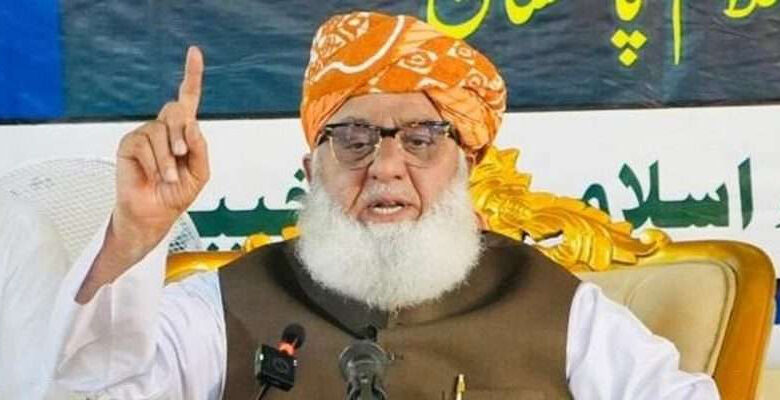
LAHORE: Senior journalist and political analyst Najam Sethi has claimed that influential circles have decided to take a tougher stance against Jamiat Ulema-e-Islam-F (JUI-F) chief Maulana Fazlur Rehman, signalling that they will no longer tolerate his political pressure.
Sethi has made several revelations about the country’s political situation, tensions between state institutions and political parties, the proposed 28th Constitutional Amendment, a possible referendum on the creation of new provinces and efforts to weaken the Pakistan Tehreek-e-Insaf (PTI).


Speaking on his programme, Sethi said a decision had reportedly been taken in political and powerful circles regarding Maulana Fazlur Rehman, with a clear message that enough was enough and a tougher strategy would now be adopted to deal with him and his political activities.
The senior analyst further claimed that state institutions had realised that existing political parties and Parliament were unwilling to undertake fundamental reforms. To break this political deadlock, a plan for a new referendum had reportedly been prepared.
Under the proposed plan, the public would be asked to express its opinion on the creation of new administrative units and the devolution of powers to lower levels of government. Sethi claimed that the referendum would include questions framed in a way that would encourage affirmative responses.
مولانا کے بارے میں فیصلہ ہو گیا ہے کہ مولانا کی ایسی کی تیسی بس اب بہت ہو گیا ! نجم سیٹھی ۔۔ https://t.co/1f56c5K2Xu
— AMJAD KHAN (@iAmjadKhann) November 8, 2026
He said that public endorsement through the referendum could put considerable pressure on political parties, particularly the Pakistan Muslim League-Nawaz (PML-N), to support the 28th Constitutional Amendment and administrative restructuring. The objective, according to Sethi, would be to establish a new constitutional framework before the 2029 general elections.
Two-Thirds Majority Challenge for 28th Amendment
Sethi said the establishment would require a two-thirds majority in Parliament to secure the passage of the proposed 28th Constitutional Amendment.
He claimed that the Pakistan Peoples Party (PPP) had made its position clear and would strongly oppose the amendment and resist it until the last moment. The PML-N, meanwhile, was maintaining silence, although the possibility of internal dissent within the party could not be ruled out.
According to Sethi, PTI’s support would be essential for the amendment to pass. However, securing that support would require substantial relief for the opposition party, which neither the establishment was currently prepared to offer nor PTI appeared willing to accept without meaningful concessions.
Consequently, he described the passage of the proposed constitutional amendment as an extremely difficult task under the existing political circumstances.
Punjab’s Growing PTI Popularity a Major Concern
The analyst also pointed to a major disagreement between the establishment and government circles over PTI’s growing popularity in Punjab and the failure to politically neutralise the party.
He claimed that influential circles believed the Punjab government and the chief minister’s team were politically weak and had failed to win public support.
Although the provincial government’s administrative performance might be satisfactory in certain areas, Sethi argued that administrative achievements were not translating into electoral support or greater political popularity.
He further said that the PML-N was unwilling to relinquish power under any circumstances and wanted to prepare for the next general elections while remaining in government.
However, he warned that if the PML-N failed to weaken or politically neutralise PTI, the situation could become a major burden for the establishment. In that scenario, state institutions might have to directly adopt tougher measures to manage political pressure, potentially creating further tensions and instability within the country’s political system.
Sethi’s remarks highlight the continuing political uncertainty surrounding constitutional reforms, the proposed referendum and the future balance of power among the country’s major political stakeholders.