Federal Constitutional Court Dismisses 1,178 Review Petitions Against Income Support Levy Act 2013 Verdict
Court Upholds December 28, 2021, Supreme Court Judgment, Stresses Senate’s Constitutional Role in Legislation
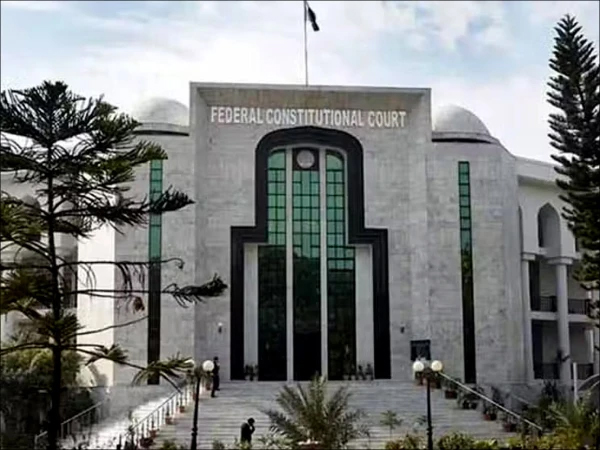
ISLAMABAD: The Federal Constitutional Court has dismissed 1,178 review petitions challenging the judgment concerning the Income Support Levy Act 2013, upholding the Supreme Court’s decision of December 28, 2021.
The court issued a detailed judgment authored by the Chief Justice of the Federal Constitutional Court, reaffirming the earlier ruling and emphasising the importance of judicial discipline, constitutional legislative procedures and the limited scope of review jurisdiction.


According to the judgment, the constitutional validity of the Income Support Levy Act had previously been examined by a two-member Supreme Court bench in the case of Commissioner Inland Revenue v. Muhammad Mustafa. On December 28, 2021, the bench dismissed the appeal.
The court noted that while review petitions against that decision remained pending, a three-member Supreme Court bench had allowed an appeal in another case on June 21, 2022, involving a substantially similar question.
The judgment authored by Justice Munib Akhtar, the court observed, raised serious concerns regarding judicial discipline, legal principles and institutional conventions.
It stressed that judicial benches must respect earlier decisions, particularly when review petitions against those judgments are already pending. Allowing an appeal in a separate case does not automatically reopen or overturn an existing judgment, it added.
The court emphasised that adherence to judicial discipline was essential to maintaining consistency and preserving the institutional structure of the judiciary.
Senate Cannot Be Bypassed in Legislation
The Federal Constitutional Court observed that legislation could not bypass the Senate where the Constitution required participation by both houses of Parliament.
It referred to Articles 70 and 73 of the Constitution, which set out the legislative procedure and the framework governing Money Bills.
The judgment stated that the Senate could not be excluded from legislation falling outside the constitutionally defined scope of Money Bills, as it represents the federating units of Pakistan.
The court stressed that legislative participation by both houses of Parliament, where constitutionally required, was not merely a procedural formality but a constitutional necessity.
It further observed that the review jurisdiction could not be treated as equivalent to an appeal. Settled disputes could not be reopened unless an identifiable error meeting the legal threshold for review was established.
A judicial decision, the court said, remained effective unless the relevant law was amended, repealed or declared unconstitutional.
Constitutional Status of the Levy
The judgment explained that the central question before the Supreme Court had been whether the Income Support Levy could constitutionally be imposed through a Money Bill.
The court referred to the earlier proceedings in which the Sindh High Court had declined to uphold the Income Support Levy Act 2013. The Supreme Court had subsequently held that the constitutionally prescribed legislative procedure had not been followed before the Finance Act was enacted.
The Federal Constitutional Court reiterated that a legislative defect could not be dismissed as an insignificant procedural irregularity where it involved compliance with constitutional requirements.
It also underscored that review jurisdiction was limited and exceptional, intended to correct errors apparent on the record rather than provide another opportunity to appeal against a concluded judgment.
By dismissing the 1,178 review petitions, the Federal Constitutional Court maintained the Supreme Court’s December 28, 2021, decision on the matter.


