What to Do If Someone Suddenly Collapses: First Five Minutes Can Save a Life
ISLAMABAD: Witnessing someone suddenly collapse and lose consciousness can be frightening, leaving family members unsure of what to do. However, taking the right steps within the first few minutes can significantly improve the person’s chances of survival, particularly if their heart has stopped beating effectively.
Cardiac surgeon Dr Santosh Gupta, speaking to Hindustan Times, stressed the importance of immediate action in such emergencies, explaining that when the heart stops pumping blood, the brain is deprived of oxygen and can suffer severe damage within minutes.


He noted that bystanders are often the only people available to provide immediate assistance, yet panic and uncertainty can prevent them from taking potentially lifesaving action.
Rather than simply waiting for an ambulance, people nearby should recognise the warning signs, call emergency services and begin appropriate first aid.
First Minute: Check Responsiveness and Breathing
If someone suddenly collapses, approach them, gently tap their shoulders and loudly ask whether they can hear you.
If the person does not respond, check whether they are breathing normally. Gasping, irregular breathing or occasional snorting sounds should not be mistaken for normal breathing, as these may indicate cardiac arrest.
If the person is unresponsive and is not breathing normally, immediately call emergency services and begin cardiopulmonary resuscitation (CPR).
Do not attempt to give the person water, force them to stand up or waste time trying to transport them to hospital in a private vehicle when emergency assistance is available.
Second Minute: Call an Ambulance and Get Help
If other people are present, assign specific responsibilities immediately.
One person should call an ambulance and put the phone on speaker so that the emergency operator can provide instructions. Another should begin CPR, while a third person can guide emergency responders to the patient’s location.
If you are alone, call emergency services on speakerphone and follow the operator’s instructions while providing assistance.
Early CPR helps maintain blood circulation to the brain and other vital organs until professional medical care becomes available.
Minutes Three to Five: Begin Chest Compressions
If the person remains unresponsive and is not breathing normally, assume cardiac arrest and begin CPR immediately.
Lay the person flat on their back on a firm, level surface. Kneel beside them and place the heel of one hand in the centre of the chest, with the other hand on top.
For an adult, follow these CPR guidelines:
Compression rate: 100 to 120 chest compressions per minute.
Compression depth: Approximately 5 to 6 centimetres.
Allow chest recoil: Let the chest return to its normal position after each compression.
Minimise interruptions: Continue compressions until the person shows signs of life, emergency responders take over or you are physically unable to continue.
People trained in CPR can provide two rescue breaths after every 30 chest compressions. If you are not trained or are unable to give rescue breaths, hands-only CPR is preferable to doing nothing.
Chest injuries, including broken ribs, can occur during CPR, but fear of causing such injuries should not prevent lifesaving efforts when cardiac arrest is suspected.
If another person is available, take turns performing compressions when fatigue sets in, preferably changing every two minutes with minimal interruption.
If an automated external defibrillator (AED) is available, ask someone to bring it immediately. Switch it on, attach the pads as directed and follow its voice instructions.
Never Give Food, Water or Medicine to an Unconscious Person
An unconscious person should not be given anything by mouth because food, water or medication could enter the airway and cause choking.
Avoid shaking the person violently, splashing water on their face or forcing them to stand.
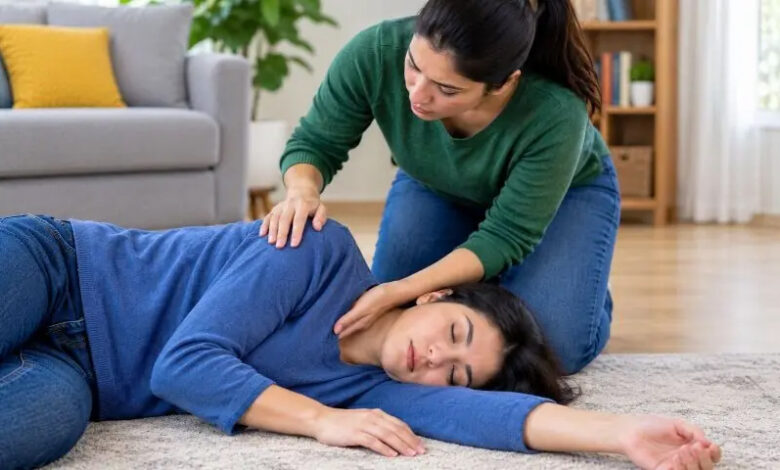
If the person is unconscious but breathing normally, call emergency services and monitor their breathing. If there is no suspicion of a spinal injury or other trauma, place them in the recovery position on their side to help keep the airway clear.
If a head, neck or spinal injury is suspected, avoid unnecessary movement and follow the emergency operator’s instructions. If breathing becomes abnormal or stops, CPR takes priority.
What If the Person Is Conscious but Has Chest Pain?
Not every cardiac emergency begins with unconsciousness. Chest pain or pressure, cold sweating, shortness of breath and sudden weakness may be warning signs of a heart attack.
In such cases, call an ambulance immediately and help the person rest in a comfortable position. Loosen tight clothing and discourage walking, climbing stairs or driving themselves to hospital, as physical exertion may increase the strain on the heart.
Do not leave the person alone. Follow the emergency operator’s advice and avoid giving new medication unless instructed by a qualified medical professional.
A heart attack and cardiac arrest are different conditions, although a heart attack can sometimes trigger cardiac arrest. Symptoms should therefore never be ignored.
Prepare Your Household for Emergencies
Families, particularly those with elderly members or people with known heart conditions, should prepare for medical emergencies in advance.
Keep emergency contact numbers in a visible place, identify the nearest hospital equipped to treat cardiac emergencies and ensure that family members know how to respond when someone collapses.
Basic CPR training can help people act confidently rather than panic during a critical situation.
Dr Gupta emphasised that although five minutes is a very short period, knowing what to do during those crucial moments can make a significant difference in saving a life.
Important: This article is for general information and does not replace professional medical advice. In a suspected cardiac arrest, contact emergency services immediately and follow the emergency operator’s instructions.