Balochistan High Court Warns Against Unauthorized Digging on Sariab Service Road, Orders Criminal Action Against Violators
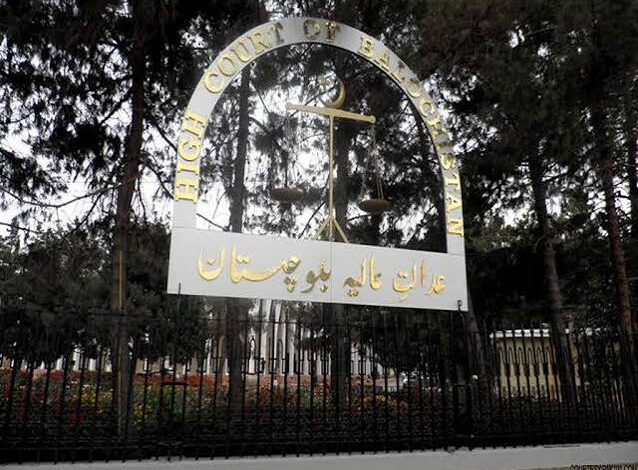
Quetta – The Balochistan High Court has issued a strict warning against unauthorized excavation on the newly constructed Sariab Service Road, terming it an unacceptable destruction of public infrastructure. A two-member bench comprising Chief Justice Muhammad Kamran Khan Malakhail and Justice Muhammad Najamuddin Mengal heard a constitutional petition related to ongoing development projects in Quetta, particularly focusing on the Sariab Service Road and the stormwater drainage system.
During the hearing, Additional Advocate General Balochistan Zahoor Ahmed Baloch, Additional Attorney General Muhammad Farid Dogar, Project Director of the Chief Minister Package for Quetta Development Muhammad Rafiq, and other relevant officials appeared before the court.


The Project Director submitted a progress report on the Sariab Service Road and stormwater drain. According to the report, the project has been divided into three phases. Out of the total 15,140 meters of road, the asphalt base course has been completed on 14,500 meters, while work remains at obstructed locations. Approximately 6,500 meters have received the asphalt wearing course. The construction of a bridge under the project has also been completed. The court was informed that 85% of the stormwater drain along the road is finished, though remaining work is delayed due to obstacles at certain points. Additionally, about 30% of kerbstone and paver installation has been done, with the rest in progress.
The court was also informed that unknown individuals from certain cable and communication companies carried out unauthorized digging on the newly built Sariab Service Road without obtaining permission from relevant authorities. This not only damaged the road and public facilities but also disrupted ongoing development work.
A letter sent by the Project Director to the Superintendent of Police, Sariab, Quetta, dated August 20, 2026, was presented in court, along with a copy of a letter from February 13, 2026, which had instructed government, semi-government, and utility agencies to use designated utility corridors on Sariab and Zarghoon Roads, including the Samungli Road utility corridor.
The court ruled that repeatedly damaging newly constructed footpaths, roads, and other civic infrastructure through unnecessary and unauthorized digging is absolutely unacceptable. All relevant agencies were directed to notify the Project Director and obtain formal permission before carrying out any new excavation or utility work. The court further ordered that wherever a utility corridor exists, it must be used, and if necessary, work should be carried out only at locations identified by the Project Director to prevent renewed damage to new roads, footpaths, and pavers.
The court made it clear that any individual or entity violating court orders would face strict legal action, which could include contempt of court proceedings. The Deputy Commissioner of Quetta was directed to ensure immediate legal action against those responsible upon receiving reports of unauthorized digging or violations from the Project Director.
The court also instructed the Additional Advocate General’s office to clearly notify all government, semi-government, and private companies that obtaining an NOC from the Project Director is mandatory before starting any work in previously developed areas, and the Project Director will also designate suitable locations for such work.
The court ruled that any violation would result in criminal proceedings against those responsible, and measures damaging public infrastructure must be strictly curbed.
During the hearing, a CMA (Civil Miscellaneous Application) No. 3504/2026 was filed by Advocate Attaullah Langove, a copy of which was provided to the Additional Advocate General. The court granted time to the Additional Advocate General to review the application.
Subsequently, the court issued an order in line with the above directives and instructed that copies of the judicial order be sent to the offices of the Additional Attorney General and the Advocate General of Balochistan for dissemination to relevant authorities and compliance.