Pakistan Urges India to Honour Indus Waters Treaty, Warns of Regional Security Risks
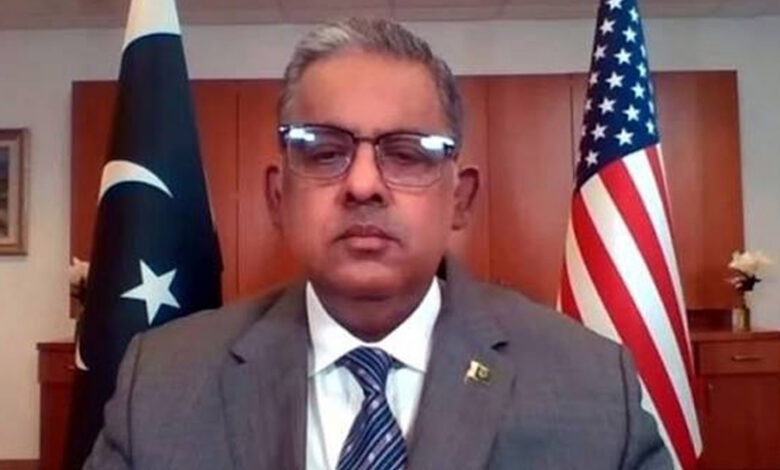
WASHINGTON:Pakistan’s Ambassador to the United States, Rizwan Saeed Sheikh, has urged India to honour the decades-old Indus Waters Treaty, warning that India’s unilateral actions pose a serious threat to peace and security in South Asia.
In an article published in a US magazine, the Pakistani ambassador gave a detailed response to an article written by India’s ambassador to the United States.


Rizwan Saeed Sheikh said India had repeatedly attempted to distort the history, structure, purpose and relevance of the Indus Waters Treaty.
He clarified that the treaty, signed in September 1960, was neither an act of Indian generosity nor a concession to Pakistan. Rather, it was the outcome of nearly a decade of negotiations, making compliance with the legally binding agreement obligatory for both parties.
Under the treaty, India was granted rights over the waters of the Ravi, Beas and Sutlej rivers, while Pakistan was allocated the waters of the Indus, Jhelum and Chenab rivers.
The Pakistani ambassador rejected India’s characterization of the agreement as unfair, saying such a claim completely ignored the circumstances and negotiations under which the treaty was concluded.
He also rejected allegations that Pakistan had attempted to obstruct India’s hydropower projects. He noted that legal proceedings had also affirmed that hydropower projects on the western rivers must comply with the limits and conditions established under the treaty.
Rizwan Saeed Sheikh said that, in this context, efforts to resolve disputes or seek arbitration did not constitute an obstruction but rather the exercise of rights available under the treaty.
“Legally, the Indus Waters Treaty remains valid, effective, operational and binding on both parties,” he maintained.
The ambassador warned that no state can escape its obligations under an international treaty by invoking unrelated political or security allegations. He said that whether based on allegations of terrorism or other bilateral disputes, such claims could not give India a unilateral right to suspend, disregard or rewrite the Indus Waters Treaty.
He stressed that the treaty contains no provision allowing either party to unilaterally suspend or terminate it. According to him, the agreement cannot be terminated unless a duly ratified treaty is concluded between the two governments.
Rizwan Saeed Sheikh urged India to fulfil its obligations under the treaty and engage in negotiations through institutional channels and the dispute-resolution mechanisms established by the agreement.