Government Ready for Talks with Political Stakeholders, but Not Armed Groups: Balochistan CM
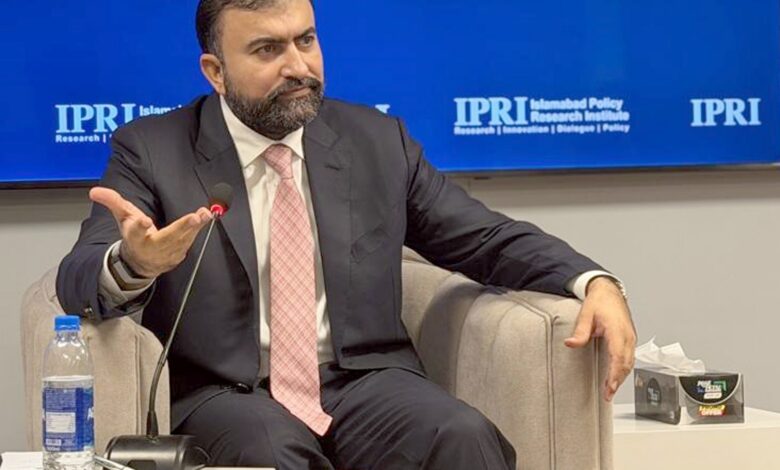
ISLAMABAD: Balochistan Chief Minister Mir Sarfraz Bugti has said that political processes are available to resolve political issues and that his government is always ready to hold talks with political stakeholders. However, he stressed that negotiations are not possible with those who take up arms and shed the blood of innocent people.
He was speaking as a special guest at a lecture organised by the Islamabad Policy Research Institute (IPRI) on Saturday, where he discussed Balochistan’s history, political evolution, security challenges and prospects for development.

Bugti said understanding Balochistan required a comprehensive assessment of its history, geography, social structure, political evolution and present-day realities. He maintained that the province’s past and present could not be understood solely through isolated incidents or one-sided narratives.
He said sustainable solutions to Balochistan’s problems depended on effective governance, meritocracy, political inclusion, opportunities for young people, economic development and the effective enforcement of the state’s writ.
Historical context and current challenges
The chief minister noted that Balochistan had a civilisation stretching back thousands of years, with Mehrgarh serving as prominent evidence of its ancient heritage. Over different periods, the region had experienced various social and political structures, including local communities, tribal systems, the Khanate of Kalat, British rule and, subsequently, Pakistan’s political and administrative system.
He said historical developments should be examined in the context of their particular political, social and regional circumstances. Referring to important historical questions, including Balochistan’s accession to Pakistan, he emphasised the need to consult authentic sources, documented records and verified references rather than relying on emotional or one-sided interpretations.
Bugti said it would be incorrect to attribute the province’s current situation solely to underdevelopment. While development disparities existed in Pakistan and other parts of the world, he argued that deprivation could not justify violence or the killing of innocent civilians.
He stressed the importance of distinguishing facts from perceptions and assessing the situation on the basis of ground realities.
Bridging the gap between the state and youth
The chief minister described reducing the gap between the state and young people as an urgent priority. He said the provincial government was listening to young people at different levels and making efforts to incorporate their concerns into policymaking.
He cited several government initiatives aimed at improving public services, including artificial intelligence-based recruitment on merit, the restoration of thousands of non-functional schools, efforts to bring out-of-school children back into education, the establishment of new schools and classrooms, and the recruitment of approximately 17,000 teachers on a merit-based contractual basis.
He also referred to the expansion of healthcare facilities and efforts to create more opportunities for women and young people, saying these measures were intended to improve public services and strengthen trust in state institutions.
Security and development go hand in hand
Bugti said peace and development were inseparable. He stated that the government was focusing on strengthening the capacity of police and law enforcement agencies, modern policing, intelligence-based operations, effective prosecution and improved coordination among institutions to address security challenges.
Alongside counterterrorism efforts, he said, the government was working to create an environment in which young people could pursue education, employment and constructive activities instead of violence.
Reiterating his position on dialogue, the chief minister said political differences should be addressed through democratic and constitutional means. However, he maintained that the protection of citizens and the enforcement of the state’s writ were non-negotiable.
He added that all democratic avenues for resolving disputes remained open within the framework of the Constitution and the law.
Bugti called for national-level discussions on Balochistan’s challenges to be grounded in research and historical evidence so that policymaking could reflect the province’s actual needs.
He concluded that a sustainable way forward for Balochistan lay in a combination of constitutional governance, democratic politics, effective administration, education, economic opportunities and improved security. A realistic assessment of the past and present, coupled with a shared strategy for the future, could help move the province towards peace, stability and development, he said.