Nawab Ayaz Jogezai Says Insecurity Is Created by Occupying Forces, Warns Against Green Pakistan Project
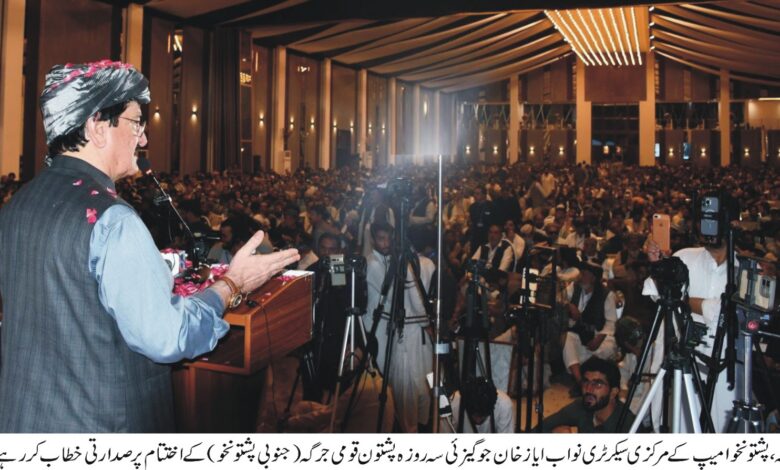
QUETTA: Pashtunkhwa Milli Awami Party (PkMAP) Central Secretary Nawab Muhammad Ayaz Khan Jogezai has said that insecurity and terrorism are being deliberately created by forces seeking to occupy the region’s land and natural resources.
He was addressing the concluding session of a three-day Pashtun National Jirga for southern Pashtunkhwa, held in Quetta from August 30 to September 1, 2026, on the invitation of PkMAP Chairman and Milli مشر Mahmood Khan Achakzai.
Nawab Jogezai congratulated the people of southern Pashtunkhwa and the Pashtun nation on what he described as a successful and historic jirga. He said the unity and solidarity demonstrated at the gathering would become part of history and serve as a milestone for future generations.
He said more than 1,400 representatives had been elected from all districts of southern Pashtunkhwa to help shape and protect the region’s future. He pledged that the decisions taken by the jirga would be implemented.
Terrorism Linked to Natural Resources
Nawab Jogezai alleged that terrorism was being spread in areas where natural resources were discovered. He said the objective was to frighten and displace local populations, seize their lands and gain control of their mineral wealth.
He said Pashtunkhwa had been pushed towards destruction through various conspiracies. The people had first been subjected to economic exploitation and were now being killed openly under different pretexts.
“People can survive under difficult circumstances, but they cannot live in insecurity,” he said, adding that lawlessness and terrorism had reached a point where citizens no longer felt safe even inside their homes.
He said the jirga was a continuation of the decisions taken at a gathering held from March 11 to 14, 2022, and would serve as a decisive institution for protecting the region and addressing its problems.
Jirga Committees to Resolve Disputes
According to Nawab Jogezai, the committees formed by the jirga would work to resolve internal disputes, tribal conflicts and longstanding rivalries in Pashtunkhwa.
He urged Pashtuns to end their internal differences, unite and organise themselves to confront what he called conspiracies against their homeland.
He said the jirga committees would represent the real strength of the people and would be respected for making impartial decisions based on Pashtun customs, traditions and principles of justice.
Call for Women’s Rights
Nawab Jogezai also spoke about the practice of giving women in compensation for tribal disputes. He said he had taken steps to end the custom when he assumed the Nawabi turban.
He said women should not be exchanged as compensation in cases of enmity and should be given their rightful share in property according to Islamic teachings and Pashtun traditions.
“We must treat women as human beings and ensure their rights,” he said.
Concern Over Exploitation of Mineral Wealth
Nawab Jogezai said the Pashtun people had not been created poor, but had been blessed with a land rich in valuable minerals and natural resources.
Despite this, he said, Pashtun youth were forced to work abroad and even collect waste from garbage dumps, while the region’s coal, chromite and other minerals were extracted for the benefit of others.
He criticised the allocation of large areas of land to outsiders through official documents, saying the lack of unity among Pashtuns had enabled such practices.
Warning Against Green Pakistan Project
Nawab Jogezai described the Green Pakistan project as a plan to take control of Pashtun land and urged the public to stay away from it.
He alleged that people were being persuaded to transfer their lands through incentives such as tractors, tube wells and solar systems, while interest-based loans could eventually lead to the loss of their property.
He warned that claims of an agricultural revolution could instead result in the destruction of agriculture in Pashtun areas.
He also expressed concern over the excessive use of groundwater through solar-powered tube wells. He said the decline in the underground water table could lead to dried-up wells and tube wells, barren lands and a serious shortage of drinking water.
Call to End Drug Cultivation
Nawab Jogezai alleged that Pashtun youth were being deliberately addicted to narcotics to weaken them mentally and distance them from their political, democratic and national rights movements.
He questioned why poppy cultivation could be eliminated in Qila Saifullah but not in Qila Abdullah, asking what kind of law and administration allowed the problem to continue.
He called for the complete eradication of poppy and heroin production across the region and urged the people to work together to protect their homeland and the future of their youth.